Table of contents
- What is the difference between an EIN vs DUNS number?
- Who issues an EIN and who issues a DUNS number?
- Does the IRS ever accept a DUNS number?
- What replaced the DUNS number for federal contracts?
- Do you need both an EIN and a DUNS number?
- Which number should you get first?
- Why are an EIN and a DUNS number both 9 digits?
- Can you get an EIN without an SSN?
- What does each number cost?
- The 3 identifiers side by side
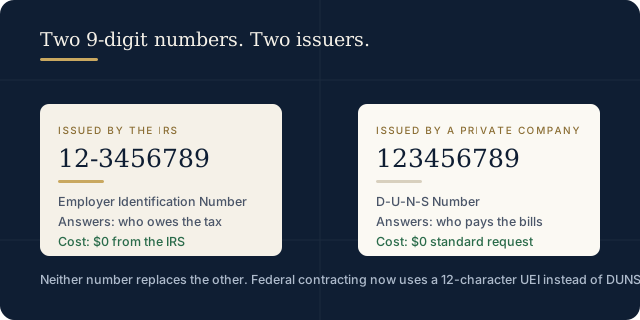
An EIN and a DUNS number both carry 9 digits and stop being alike there. The IRS issues the EIN to identify a business for federal tax, at $0. Dun & Bradstreet, a private company, issues the DUNS number to identify a business for commercial credit, also at $0. Neither number substitutes for the other on any form.
One of these 2 numbers is required by federal law and the other is required by nobody. Reading them as interchangeable puts the wrong 9 digits on a tax form, and the IRS notice about that error arrives months later, after the filing season closes.
What is the difference between an EIN vs DUNS number?
An EIN is a 9-digit federal tax number the IRS issues. A DUNS number is a 9-digit credit identifier Dun & Bradstreet issues. One government agency assigns the first, one private company assigns the second.
The two numbers answer two different questions. An EIN answers who owes the tax. A DUNS number answers who pays the bills. No form asks the first question and accepts the second number as the reply.
The digit count is a coincidence and it causes most of the confusion. An EIN prints as 2 digits, a hyphen, then 7, in the pattern 12-3456789. A DUNS number prints as 9 unbroken digits with no hyphen at all.
Authority separates them more than format does. Federal law backs the EIN, so a bank, a payroll provider, and the IRS all treat it as identity. A commercial database backs the DUNS number, so lenders and suppliers treat it as reputation.
One entity holds both numbers at once without conflict. The EIN sits on the tax return and the DUNS number sits in a credit file, and the two records never touch.
Who issues an EIN and who issues a DUNS number?
The Internal Revenue Service issues every EIN, on Form SS-4, at a fee of $0. Dun & Bradstreet issues every DUNS number through its own request process, at $0 for the standard request.
The IRS is a federal agency, and an EIN assignment is an official act. The agency confirms it in writing with a CP-575 notice, and reissues that confirmation as a 147C letter on request afterwards.
Dun & Bradstreet is a commercial data company, not a government body. It maintains a business credit database, and the DUNS number is the key it uses to file each business record inside that database.
The distinction decides who can compel you. The IRS requires an EIN of any entity with employees, an excise liability, or a corporate or partnership return. No agency requires a DUNS number of any business.
Neither issuer charges for the number itself. An EIN costs $0 from the IRS, in year 1 and in every year after, because an EIN never renews and never expires.
Does the IRS ever accept a DUNS number?
No. No IRS form has a field for a DUNS number. Form W-9, Form 941, Form 1120, and Form 1099-NEC all request a taxpayer identification number, which for a business entity means the EIN.
Part I of Form W-9 is the field where the mistake shows up most. A vendor writes 9 digits into the taxpayer identification number box, and a DUNS number entered there produces a name-and-number mismatch when the payer files the 1099.
The mismatch surfaces months later, not immediately. The IRS matches the reported number against its own records after the filing season, and the payer receives a notice, so the vendor learns about the error long after supplying it.
Backup withholding is the cost of that error. A payer who cannot produce a valid taxpayer identification number for a payee withholds from the payment, which turns a paperwork slip into a cash-flow problem.
The correction is the EIN itself. A business supplies the 9-digit number the IRS assigned, in the 2-digit and 7-digit pattern, and the DUNS number stays where it belongs, in a credit application.
What replaced the DUNS number for federal contracts?
The Unique Entity ID replaced it. GSA stopped using DUNS numbers in SAM.gov on April 4, 2022, and SAM.gov now assigns a 12-character alphanumeric Unique Entity ID at $0.
GSA, the agency that runs SAM.gov, published both facts: the April 4, 2022 cutover date and the 12-character length of the identifier that replaced the DUNS number. This change removed the single strongest reason a small business had for getting a DUNS number, because federal registration was the one place a government system required a privately issued identifier.
The Unique Entity ID differs from both other numbers in shape. It runs 12 characters and mixes letters with digits, so it never gets confused with a 9-digit EIN or a 9-digit DUNS number on a form.
SAM.gov assigns it during entity registration, and the registration also requires an EIN. A business seeking federal work therefore needs the EIN and the Unique Entity ID, and needs the DUNS number for neither step.
The DUNS number kept its commercial role after the change. Suppliers, insurers, and lenders that use Dun & Bradstreet data still reference it, which is a private-sector relationship rather than a government requirement.
Do you need both an EIN and a DUNS number?
Most businesses need only the EIN. The IRS requires an EIN of any entity with employees, a corporate return, or a partnership return. No law requires a DUNS number of any business at any time.
The EIN requirement is mechanical. An entity that hires 1 employee needs one for payroll tax. A corporation needs one to file Form 1120. A multi-member LLC needs one to file its partnership return. A foreign-owned single-member LLC needs one to file Form 5472.
Banks add a practical requirement on top of the legal one. A US business bank account opens against an EIN and the CP-575 that confirms it, and no US bank accepts a DUNS number in that field.
The DUNS number becomes useful in 3 situations: applying for trade credit with a supplier that pulls Dun & Bradstreet data, bidding on private contracts where a buyer checks a credit file, and building a business credit profile separate from a personal one.
A business with no supplier credit and no credit-checked customers gains nothing from the second number. The honest answer for a new single-owner company is one number, not two.
Which number should you get first?
Get the EIN first. A DUNS record is built around a legal entity, and the EIN is the number that proves the entity exists to the IRS, to a bank, and to any counterparty checking it.
Sequence matters because a credit file inherits the identity you give it. A DUNS record opened before the entity settles its legal name carries that error forward into every credit report drawn from it.
The EIN also unlocks the account that credit activity flows through. A business bank account requires the EIN, and trade credit reported against a business rather than an owner requires that account to exist first.
The practical order runs in 4 steps: form the entity with the state, obtain the EIN from the IRS, open the business bank account, then request the DUNS number if a supplier or lender asks for one.
Skipping straight to step 4 is the common mistake. It produces a credit file for a business that cannot yet transact, and the file sits empty because nothing reports into it.
Why are an EIN and a DUNS number both 9 digits?
The match is coincidence. Two independent systems settled on 9 digits, and neither derives from the other. The formats still differ: an EIN prints as 12-3456789 and a DUNS number prints as 123456789.
The hyphen is the fastest visual test. An EIN carries exactly 1 hyphen, after the 2nd digit. A DUNS number carries 0 hyphens. A Social Security Number carries 2, splitting the 9 digits into 3, 2, then 4.
The first 2 digits of an EIN form a prefix the IRS assigns by processing campus. Those digits encode no state and no industry, so reading location out of an EIN prefix produces a wrong answer.
A DUNS number encodes nothing at all. Every digit in it is sequential filing information inside a private database, which is why no part of it can be validated by inspection.
Context settles ambiguity when format does not. A 9-digit number printed on a tax form, a bank application, or a payroll record is an EIN. A 9-digit number printed on a credit application or a supplier onboarding form is a DUNS number.
Can you get an EIN without an SSN?
Yes. Form SS-4 line 7b accepts the entry Foreign in place of an SSN or ITIN. The IRS assigns the EIN by fax or phone rather than through the online tool, which requires a US identity number.
The online application is the only route that hard-blocks a person without an SSN. The fax route accepts the same Form SS-4 and produces the same 9-digit number and the same CP-575 letter.
Two fax numbers cover the two cases. An entity based in a US state faxes 855-641-6935. An entity with no US location faxes 855-215-1627. International applicants also reach the IRS by phone at 267-941-1099.
No passport upload enters this process at any point. The IRS asks for the responsible party's name, the entity's legal name, and the reason for applying, and line 7b takes the word Foreign where a number would otherwise go.
The DUNS side carries no identity-number requirement of its own, because Dun & Bradstreet identifies a business rather than a person. The gating step for a non-resident founder is the EIN, which is exactly why it comes first.
What does each number cost?
Both numbers cost $0 from their issuers. The IRS charges $0 for an EIN on Form SS-4. Dun & Bradstreet charges $0 for a standard DUNS request. Filing services charge for the work, never for the number.
The $0 fee holds in year 2 and beyond as well. An EIN never renews, never expires, and carries no maintenance charge, so the lifetime cost of the number from the IRS is $0.
What a service charges covers preparation and filing, not the number. That distinction is the honest one, and any page that implies the IRS sells EINs has the fact backwards.
The prices below are the published rates for EIN filing, verified July 2026. They exist so the comparison is complete, and the $0 self-file route stays on the table above all of them.
| Route to an EIN | Price | Written deadline | Works without an SSN |
|---|---|---|---|
| IRS directly, Form SS-4 | $0 | None | Yes, by fax |
| ein-number.com | $99 | 7 business days | Yes |
| Northwest | $200 | None | Yes |
| ZenBusiness | $99 | None | Not stated |
| Rocket Lawyer | $59.99 | None | Not stated |
| Dun & Bradstreet, standard DUNS request | $0 | None | Yes |
Prices verified July 2026. IRS and Dun & Bradstreet fees are the issuers' own published figures.
How do the EIN, the DUNS number, and the Unique Entity ID compare?
Three identifiers, three issuers. The IRS issues the 9-digit EIN for tax. Dun & Bradstreet issues the 9-digit DUNS number for credit. SAM.gov issues the 12-character Unique Entity ID for federal registration. All 3 cost $0.
| Attribute | EIN | DUNS number | Unique Entity ID |
|---|---|---|---|
| Issuer | IRS, a federal agency | Dun & Bradstreet, a private company | SAM.gov, run by GSA |
| Length | 9 digits | 9 digits | 12 characters |
| Format | 12-3456789 | 123456789 | Letters and digits mixed |
| Purpose | Federal tax identity | Commercial credit identity | Federal award registration |
| Required by law | Yes, for many entities | No | Only to receive federal awards |
| Accepted on IRS forms | Yes | No | No |
| Opens a US bank account | Yes | No | No |
| Issuer fee | $0 | $0 standard request | $0 |
| Renewal | Never, $0 in year 2 and after | None | Registration renews annually |
| Confirmation document | CP-575, reissued as 147C | A credit file record | A SAM.gov registration record |
| Application form | Form SS-4 | A Dun & Bradstreet request | SAM.gov entity registration |
| Works without an SSN | Yes, line 7b takes Foreign | Yes | Requires an EIN first |
Sources: IRS, GSA SAM.gov, and Dun & Bradstreet, verified July 2026.
How does someone without an SSN get the EIN half of this pair?
Two honest routes exist. Anyone holding an SSN applies at irs.gov, free, in about 15 minutes. Anyone without one uses the fax route with Form SS-4 line 7b marked Foreign, or hands the filing to a service.
Have an SSN? Go to irs.gov. The application is free and finishes in about 15 minutes, and the number appears on screen at the end. Paying anyone for that is paying for 15 minutes of typing.
No SSN? The online tool blocks you and the fax route does not. Fax Form SS-4 to 855-641-6935 if the entity is based in a US state, or to 855-215-1627 if it is not. Line 7b takes the word Foreign. Or we file it for $99.
The DUNS half of the pair carries no such split, because Dun & Bradstreet identifies the business rather than the person behind it. That is why the EIN is the step that decides a non-resident founder's timeline, and the DUNS number is the step that waits.
What else do people ask about an EIN vs a DUNS number?
Ten questions cover the rest: which form takes which of the 2 numbers, what federal contractors have needed since 2022, what a US bank asks for, and what each number costs from its issuer.
+Is a DUNS number the same as an EIN?
No. Both carry 9 digits and nothing else about them matches. The IRS issues the EIN for federal tax at a fee of $0, and Dun & Bradstreet, a private company, issues the DUNS number for commercial credit at $0 for a standard request. Neither number is valid in the other's place on any form.
+Can I put a DUNS number on Form W-9?
No. Part I of Form W-9 asks for a taxpayer identification number, which for a business entity means the 9-digit EIN printed in the 12-3456789 pattern. A DUNS number entered in that box causes a name-and-number mismatch when the payer files the 1099, and the IRS notice arrives months later. Backup withholding follows.
+Do federal contractors still need a DUNS number?
No. GSA stopped using DUNS numbers in SAM.gov on April 4, 2022, and replaced them with the 12-character Unique Entity ID, which SAM.gov issues at $0 during entity registration. That registration still requires an EIN, so a contractor needs 2 numbers and the DUNS number is not one of them.
+Which number do I need to open a business bank account?
The EIN. US banks open business accounts against the 9-digit EIN and the CP-575 letter the IRS issued to confirm it, alongside the formation documents. No bank accepts a DUNS number in that field, because a DUNS number sits in a private credit database and carries no federal tax authority at all.
+Do I need a DUNS number to build business credit?
Only for credit reported through Dun & Bradstreet. Its scoring draws on supplier payment history filed against the DUNS record, so the number is the key that file sits under. Other business bureaus build a file without one. Every route starts with the EIN, because the business bank account that credit activity flows through requires the 9-digit EIN and the CP-575.
+Which should I get first, an EIN or a DUNS number?
The EIN, in 4 steps: form the entity with the state, get the EIN from the IRS at $0, open the business bank account, then request the DUNS number if a supplier or lender asks for one. A credit file opened first inherits any legal-name error and carries it into every later report.
+Can a non-US resident get both numbers?
Yes. Form SS-4 line 7b accepts the entry Foreign in place of an SSN or ITIN, and the IRS assigns the EIN by fax at 855-641-6935 for US-based entities or 855-215-1627 for international ones. Dun & Bradstreet identifies businesses rather than people, so it asks for no personal identity number of any kind.
+How much does each number cost?
The IRS charges $0 for an EIN and Dun & Bradstreet charges $0 for a standard DUNS request. An EIN also costs $0 in year 2 and in every year after, because it never renews and never expires. A filing service charges for preparation and filing work, never for the 9 digits themselves.
+Why are both numbers 9 digits long?
Two unrelated systems chose the same length, and neither derives from the other. Format still separates them cleanly: an EIN carries 1 hyphen after the 2nd digit, a DUNS number carries 0 hyphens across its 9 digits, and a Social Security Number carries 2 hyphens splitting it 3, then 2, then 4.
+What if my business has neither number yet?
Start with the EIN, because the IRS requires it of any entity with employees, a corporate return, or a partnership return. The IRS charges $0 and anyone holding an SSN files it free at irs.gov. ein-number.com files it for $99 and delivers the EIN and CP-575 within 7 business days or refunds it.
This page states IRS, GSA, and Dun & Bradstreet procedures current as of July 2026. It is not legal or tax advice. ein-number.com is not affiliated with the IRS or with Dun & Bradstreet.
Need the EIN before the credit file?
The EIN has to exist first, and the IRS charges $0 for it. We prepare Form SS-4, file within 1 business day, and deliver the EIN and CP-575 within 7 business days or refund the $99.
No SSN. No passport upload. · EIN number delivery, in writing