Table of contents
- What does an EIN number example look like?
- What do the first 2 digits of an EIN mean?
- Which EIN prefixes does the IRS actually use?
- How does an EIN example differ from an SSN or ITIN example?
- Where does your EIN example appear on your documents?
- How do you check whether an EIN example is valid?
- Does an EIN example ever change or expire?
- Why do people look for an EIN number example?
- What does an EIN example look like without an SSN?
- EIN, SSN, ITIN and DUNS side by side
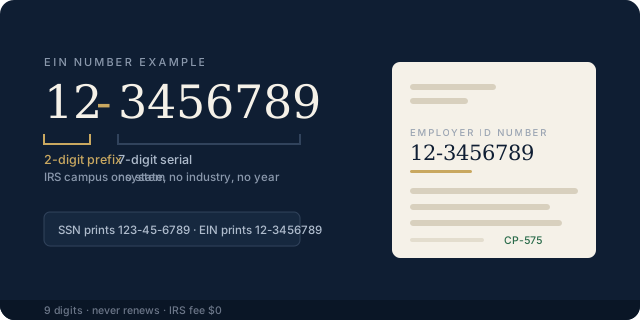
An EIN number example looks like 12-3456789: 2 digits, a hyphen, then 7 digits, for 9 digits in total. The first 2 digits are an IRS prefix that records which campus or system assigned the number. Nothing in the 9 digits encodes a state, an industry, or a year, and the number never changes once it is issued.
Most pages on this topic print one sample number and stop. This one covers the whole format: the 2-digit prefix and what it records, the published IRS prefix list, the 3 identifiers an EIN is confused with, and the 3-step test that separates a mistyped number from a real one. Updated July 2026.
What does an EIN number example look like?
An EIN number example looks like 12-3456789: 2 digits, a hyphen, then 7 digits. Every EIN the IRS has issued carries exactly 9 digits in that pattern, with the hyphen after the second digit.
The hyphen is a display convention, not part of the number. IRS systems store 9 digits with no separator, which is why Form W-9 line 6 prints boxes rather than a hyphen, and why a bank portal accepts 123456789 and 12-3456789 as the same entry.
The 9-digit length is fixed. An EIN issued decades ago is 9 digits and an EIN issued this morning is 9 digits, because the IRS has never widened the field. A 10-digit string on a document is a typo, not a longer EIN.
Leading zeros are real digits and survive every step. A number printed as 01-2345678 keeps that zero on the CP-575, in the bank record, and on every Form 1099 filed under it. Dropping it produces a mismatch that the IRS reads as a different taxpayer.
The IRS also calls the same 9 digits a federal employer identification number and a business tax ID. The name on the form changes; the format on this page does not. That is the whole reason a single format article answers questions filed under half a dozen different labels.
What do the first 2 digits of an EIN mean?
The first 2 digits are the prefix, and they record which IRS campus or system assigned the number. The prefix encodes no state, no industry, and no year. The remaining 7 digits are a sequence.
Before 2001 the prefix did map to geography, because each IRS district office issued numbers for the businesses in its territory. That link was broken when assignment was centralized, and it has not existed for the entire online-application era.
Applications filed through the IRS online assistant draw from an internet block of 21 prefixes, including 20, 26, 27, 45, 46, 47 and 93. The block is not exclusive: 12 of its 21 prefixes also sit in the Philadelphia list. A number starting with 27 says the application arrived online, and nothing at all about where the business sits.
This matters in verification work. A vendor in Florida holding a prefix from the Brookhaven block is not evidence of anything wrong, and refusing a W-9 on that basis wastes a week. Only a name match against IRS records tests whether a number is genuine.
The 7-digit serial carries no readable meaning either. It is not sequential by date in any way an outsider can reconstruct, so two businesses formed the same week hold serials with no relationship to each other.
Which EIN prefixes does the IRS actually use?
The IRS publishes a fixed list of valid EIN prefixes, each mapped to the campus or system that assigns it. Philadelphia holds 28, the largest of the 12 groups, then Brookhaven with 24 and the internet block with 21.
The list is the only published key to the first 2 digits, and it is short enough to read in a minute. A prefix outside it is a signal that the number was mistyped, invented, or copied from a Social Security Number.
Twelve prefixes appear in more than one group: 33, 39, 41, 42, 46, 85, 86, 87, 88, 92, 93 and 99 sit in both the Philadelphia list and the internet block, because the campus and the online system draw from overlapping ranges. A prefix therefore narrows the origin of a number without ever proving it, which is the correct level of confidence to give it.
The 12 groups cover 83 distinct prefixes in total. Every 2-digit value outside that set fails the check on sight, and that single comparison is the entire value of the published list.
| Assigning campus or system | Valid EIN prefixes | Prefixes in block |
|---|---|---|
| Brookhaven | 01, 02, 03, 04, 05, 06, 11, 13, 14, 16, 21, 22, 23, 25, 34, 51, 52, 54, 55, 56, 57, 58, 59, 65 | 24 |
| Philadelphia | 33, 39, 41, 42, 43, 46, 48, 62, 63, 64, 66, 68, 71, 72, 73, 74, 75, 76, 77, 85, 86, 87, 88, 91, 92, 93, 98, 99 | 28 |
| Internet (IRS online assistant) | 20, 26, 27, 33, 39, 41, 42, 45, 46, 47, 81, 82, 83, 84, 85, 86, 87, 88, 92, 93, 99 | 21 |
| Cincinnati | 30, 32, 35, 36, 37, 38, 61 | 7 |
| Andover | 10, 12 | 2 |
| Atlanta | 60, 67 | 2 |
| Austin | 50, 53 | 2 |
| Fresno | 15, 24 | 2 |
| Kansas City | 40, 44 | 2 |
| Memphis | 94, 95 | 2 |
| Ogden | 80, 90 | 2 |
| Small Business Administration | 31 | 1 |
Source: IRS, How EINs are Assigned and Valid EIN Prefixes, verified July 2026. Twelve prefixes — 33, 39, 41, 42, 46, 85, 86, 87, 88, 92, 93 and 99 — appear in both the Philadelphia and internet blocks, so the 12 rows list 95 entries covering 83 distinct prefixes.
Which 9-digit numbers get mistaken for an EIN?
Three: the SSN, the ITIN, and the DUNS number. All 4 identifiers hold 9 digits, so the hyphen positions and the issuing agency are what separate them on a document.
| Identifier | Pattern | Example | Digits | Issued by | Issuer fee |
|---|---|---|---|---|---|
| EIN | 2 digits, hyphen, 7 digits | 12-3456789 | 9 | IRS | $0 |
| SSN | 3 digits, 2 digits, 4 digits | 123-45-6789 | 9 | Social Security Administration | $0 |
| ITIN | SSN shape, first digit always 9 | 9XX-XX-XXXX | 9 | IRS | $0 |
| DUNS number | 9 digits, no hyphen | 123456789 | 9 | Dun & Bradstreet | Not an IRS or SSA fee |
Sources: IRS and the Social Security Administration, verified July 2026. The 3 federal identifiers carry a $0 issuer fee from those 2 agencies. The DUNS number is issued by Dun & Bradstreet, a private company that neither agency sets a fee for, so no figure is stated here. A DUNS number identifies a business for credit reporting and never replaces an EIN on a tax filing.
How does an EIN example differ from an SSN or ITIN example?
An EIN prints as 2 digits then 7, as in 12-3456789. An SSN prints as 3 digits, 2, then 4, as in 123-45-6789. An ITIN uses the SSN shape and always begins with 9.
The hyphen positions separate all three at a glance, which is the fastest check on a scanned document. One hyphen after 2 digits is an EIN. Two hyphens, after 3 digits and after 5, is an SSN or an ITIN.
The ITIN adds a rule the other two lack: the first digit is always 9, and the number is issued to an individual who is not eligible for an SSN. An ITIN is never an EIN, and an entity cannot file its payroll returns under one.
A sole proprietor with no employees reports under an SSN and holds no EIN, so a request for a 9-digit business number comes back in the wrong shape entirely. Reading the hyphens catches that before it becomes a filing error.
All three are 9 digits, which is exactly why the shapes matter. Length alone distinguishes nothing, and a system that only counts digits accepts an SSN in an EIN field without complaint.
Where does your EIN example appear on your documents?
The EIN prints on the CP-575 assignment letter, the 147C replacement letter, Form W-9 line 6, Form 941, Form W-2 box b, and every Form 1099 issued under the business.
The CP-575 is the original. The IRS issues it once, at assignment, and it carries the 9 digits alongside the exact legal name the IRS holds. Banks ask for it because it is the only document created by the IRS at the moment the number came into existence.
The 147C is the replacement, and it carries the same 9 digits. The IRS issues it on request to the responsible party or another authorized person, and it satisfies the same bank checks the CP-575 does. There is no third official source.
Everything else is a copy. A tax return, a payroll filing, and a prior 1099 all print the number, and any of them serves as a memory aid. None of them proves the pairing of number and legal name, because the filer typed it rather than the IRS.
Check the name before the number when comparing two documents. An entity written as LLC on the CP-575 and L.L.C. on a bank form fails the match on the letters, not the digits, and that is the more common cause of a rejected application.
How do you check whether an EIN example is valid?
Confirm 9 digits in the 2-and-7 pattern, confirm the first 2 digits appear on the IRS prefix list, then match the number to the exact legal name in IRS records through a 147C letter.
The first two checks cost $0 and need no tool beyond the 2 lists on this page. They catch transcription errors, which are the cause of most failed lookups: 0 and O look alike in a scan, as do 1 and 7, and a single wrong character produces a number belonging to nobody.
The third check is the only one that proves anything. Format is necessary and nowhere near sufficient, because any 9 digits can be typed in the right shape. A number is real when the IRS confirms that it and a specific legal name belong together.
For a counterparty rather than your own entity, a signed Form W-9 is the practical route. Line 6 carries the number and the signature attests it is correct, which is stronger evidence than any aggregator selling a database search.
Treat an online validator with the skepticism its output deserves. Nothing outside the IRS holds the master file, so a tool reporting a number as valid has checked the shape and the prefix, which are the 2 checks you already did by eye.
Does an EIN example ever change or expire?
No. An EIN never expires, never renews, and costs $0 in year 2 and every year after. The same 9 digits survive a name change, an address change, and a move to another state.
The IRS retires a number rather than reissuing it. A closed account keeps its 9 digits permanently attached to that entity, and the IRS assigns them to no one else, which is why a number found on a 20-year-old filing still identifies the same business.
A name change keeps the EIN. The business reports the new name to the IRS, and the number stays fixed, which is exactly why a reverse search on an old number returns an old name and confuses the searcher.
An address or responsible-party change keeps it too, and travels on Form 8822-B rather than a new application. Filing a fresh Form SS-4 to update an address creates a second EIN and a second set of filing obligations.
A change of entity structure is the case that does require a new number. A sole proprietorship incorporating, or a partnership becoming a corporation, receives a new 9-digit EIN, because the IRS treats the result as a different taxpayer.
Why do people look for an EIN number example?
Four reasons: checking a number on a W-9 or invoice before using it, filling an EIN field on a form, teaching a bookkeeping system the format, and confirming a remembered number has the right shape.
The verification case is the largest. A number arrives on a vendor form and the reader wants one quick test before the payment system stores it, and the 2-and-7 shape plus the prefix list is that test.
The form-filling case is narrower and more urgent. A field rejects an entry, and the applicant needs to know whether to type the hyphen. Both forms are accepted by IRS e-file systems, and 9 digits with no separator is the safest entry when a field refuses punctuation.
The recall case is the one that resolves fastest. Someone remembers 8 digits and wants to know how many are missing, and the answer is that an EIN is 9 digits, so a remembered 8-digit string is incomplete rather than unusual.
The fourth case is a new business that has no number yet and is reading the format before applying. That reader needs the application route, not the format, and the routing below settles it in one line.
What does an EIN example look like without an SSN?
Identical. An EIN issued to an owner with no SSN carries the same 9 digits in the same 2-and-7 format, on the same CP-575 letter. Nothing in the number records the owner's identification.
Form SS-4 line 7b is the line that makes this work. It accepts the entry Foreign for a responsible party who holds no SSN and no ITIN, and the IRS assigns the EIN on that basis. No passport upload is requested at any point in the process.
The route changes, not the result. An applicant with an SSN uses the IRS online assistant and receives the number in about 15 minutes. An applicant without one files Form SS-4 by fax, to 855-641-6935 for an entity based in a US state or 855-215-1627 from outside the United States.
The IRS charges $0 on both routes. The fee difference between them is zero, and any service charging for an EIN is charging for the filing work and the deadline, never for the number itself.
The international IRS line is 267-941-1099 for applicants calling from outside the United States. It is the same office that processes the fax route, and it answers questions about an application already sent.
What else do people ask about an EIN number example?
+What is an example of an EIN number?
12-3456789 is a correctly formatted EIN number example: 2 digits, a hyphen, then 7 digits, 9 in total. Every EIN the IRS has ever issued uses that shape. The first 2 digits are a prefix recording the assigning IRS campus or system, and the last 7 are a serial with no readable meaning.
+How many digits is an EIN?
An EIN is 9 digits, displayed as 2 digits, a hyphen, then 7. The hyphen is formatting rather than data, so 12-3456789 and 123456789 are the same number. A string of 8 digits is incomplete and a string of 10 digits contains a typo, because the IRS has never issued either length.
+Do the first 2 digits of an EIN mean anything?
They identify the IRS campus or system that assigned the number, and nothing else. Before 2001 the prefix mapped to a geographic district; centralized assignment ended that. Online applications draw from an internet block of 21 prefixes, so a prefix of 27 shows the route used, not the state of the business.
+What is the difference between an EIN and an SSN format?
An EIN prints as 2 digits, a hyphen, then 7, as in 12-3456789. An SSN prints as 3 digits, 2 digits, then 4, as in 123-45-6789. Both hold 9 digits, so the hyphen positions are the only visual difference and the fastest check on a scanned document.
+Can an EIN start with 0?
Yes. Prefixes 01 through 06 are valid and belong to the Brookhaven block, so 01-2345678 is a properly formed EIN. The leading zero is a real digit and belongs in every field it is entered into. Dropping it leaves 8 digits, which the IRS reads as a different taxpayer or no taxpayer.
+Is there a way to tell if an EIN example is fake?
Three checks, in order. Confirm 9 digits in the 2-and-7 pattern, confirm the first 2 digits appear on the published IRS prefix list, then match the number to the exact legal name through a 147C letter. Only the third check proves anything, because any 9 digits can be typed in the right shape.
+Does an EIN ever expire or need renewing?
Never. An EIN carries no expiry date and no renewal, and it costs $0 in year 2 and every year after. The same 9 digits survive a business name change, an address change, and a move between states. The IRS retires a closed account's number rather than reassigning it.
+Where can I see a real EIN example?
On your own CP-575 assignment letter or 147C letter, on Form W-2 box b, and on any Form 1099 your business issued. For other entities, public company EINs appear in SEC filing headers and nonprofit EINs appear on page 1 of Form 990. All of those sources cost $0.
+Can I get an EIN without an SSN?
Yes. Form SS-4 line 7b accepts the entry Foreign for a responsible party with no SSN and no ITIN, and no passport upload is requested. The application goes by fax to 855-641-6935 for a US-based entity or 855-215-1627 from abroad. The IRS fee is $0 on every route.
+What does an EIN cost?
The IRS charges $0, on the online route and the fax route alike, in year 1 and in every year after. Filing services charge for preparation and a deadline rather than for the number. ein-number.com files for $99 and delivers the EIN and CP-575 within 7 business days or refunds it automatically.
This page states IRS procedures and formats current as of July 2026. Sample numbers are illustrative and belong to no entity. This is not legal or tax advice. ein-number.com is not affiliated with the IRS.
Reading the format because you do not have a number yet?
The IRS charges $0 for an EIN, and an applicant with an SSN should apply at irs.gov in about 15 minutes. Without an SSN the route is Form SS-4 by fax, with Foreign on line 7b. We prepare it, file within 1 business day, and deliver the 9-digit EIN and the official IRS CP-575 within 7 business days, or refund the $99 automatically. Business days are Monday to Friday, excluding US federal holidays.
No SSN. No passport upload. · the guaranteed EIN filing service