How do you verify an EIN number?
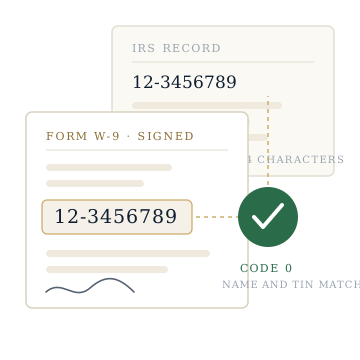
You verify an EIN number through 6 official routes: a signed Form W-9, IRS TIN Matching, a CP-575 or 147C letter, SEC EDGAR, the IRS Tax Exempt Organization Search, and the IRS valid-prefix list.
Verification is a stricter act than a lookup. A ein number lookup finds a 9-digit number. Verification proves that the number and one exact legal name sit together in IRS records. Only 3 of the 6 routes read IRS data at the moment you ask, being TIN Matching, a 147C request, and the Tax Exempt Organization Search. The other 3 read a document the IRS or the business created earlier.
Route 1: Check the 9 digits against the IRS prefix list
An EIN prints as 2 digits, a hyphen, then 7 digits. The IRS publishes every prefix in use, and a number carrying an unassigned prefix such as 07, 17, or 89 is not an EIN.
Proves the number is structurally capable of being an EIN. It proves nothing about which business holds it, so it is a filter rather than a verification.
Route 2: Collect a signed Form W-9 from the business
Form W-9 pairs the legal name on line 1 with the taxpayer identification number in Part I, and the signature attests under penalties of perjury that the number is correct.
Proves the business asserts that name and EIN pairing in writing. It is the document the IRS expects a payer to hold before filing a Form 1099.
Route 3: Run the pairing through IRS TIN Matching
IRS TIN Matching compares a name and EIN pair against IRS records and returns 1 of the 9 numeric codes, 0 through 8, defined in IRS Publication 2108A. Enrollment runs through IRS e-Services and is open to payers of information returns.
Proves the pairing matches IRS records at the moment of the check. It is the only route that reads IRS data directly for a private company.
Route 4: Read the CP-575 or the 147C letter
The IRS issues one CP-575 per EIN at assignment and never reprints it. The 147C letter replaces it, and the IRS releases the 147C to an authorized person at $0.
Proves the pairing as the IRS recorded it. Banks treat the CP-575 as the primary document and accept no screenshot in its place.
Route 5: Search the SEC EDGAR filing header
EDGAR prints the EIN in the header of every 10-K, 10-Q, and 8-K under the label IRS number. Federal securities law makes the filing mandatory for a public company.
Proves the EIN of a public company from a filing the company signed. It covers no private company and no sole proprietor.
Route 6: Search the IRS Tax Exempt Organization Search
The IRS publishes the EIN of every registered tax-exempt organization across 5 datasets, including the automatic revocation list and Form 990-series returns.
Proves the EIN and the current exempt status of a nonprofit. A revoked organization appears on the revocation list under the same EIN.
Sources: IRS Publication 2108A, IRS Form W-9 instructions, and SEC EDGAR, verified July 2026.
What does a valid EIN number look like?
A valid EIN carries 9 digits printed as 2 digits, a hyphen, then 7 digits. The IRS publishes every prefix in use, so a number starting with 07, 17, or 89 fails on sight.
The 2-digit prefix once recorded the IRS campus that issued the number, which is why an old EIN and a business address rarely agree. Since 2001 the prefix records the assignment system rather than a location, so a company in Texas holds an internet-assigned prefix and an office in Wyoming holds the same one. Reading geography out of a prefix produces a wrong answer.
A format check does one job, and it needs no contact with anyone: it removes numbers that no business holds. A Social Security Number prints as 3 digits, 2 digits, then 4 digits, so a 9-digit string punctuated in that pattern belongs to a person rather than an entity. An EIN and an SSN share a length and share nothing else.
| Check | Pass | Fail |
|---|---|---|
| Digit count | Exactly 9 digits | 8 or 10 digits |
| Punctuation | 2 digits, hyphen, 7 digits | 3 digits, hyphen, 2 digits, hyphen, 4 digits |
| Characters | Numerals only | Any letter or symbol |
| Prefix | A prefix the IRS lists as in use | 07, 08, 09, 17, 18, 19, 28, 29, 49, 78, 79, 89 |
| Leading zeros | Retained, as in 04-1234567 | Dropped by a spreadsheet |
Source: the IRS page How EINs are Assigned and Valid EIN Prefixes, verified July 2026.
Leading zeros account for a large share of the numbers that arrive broken. A spreadsheet reads 04-1234567 as a number, drops the zero, and hands over 41234567 with 8 digits. Store an EIN as text. Read the anatomy of the format on the EIN number example page.
How do you verify your own EIN number?
Read the CP-575 the IRS issued at assignment. When it is lost, request a 147C letter, which the IRS reissues at $0 to an authorized person and returns by fax or mail.
The IRS issues 1 CP-575 per EIN and never reprints it. That single fact governs the whole document chain. Every later copy of the number, on a Form 1120, a Form 941, a Form W-2 box b, or a bank application, is a transcription of that one letter. A transcription verifies nothing about the name pairing, because a typo travels forward unchallenged.
Two documents carry the pairing with IRS authority. The CP-575 records it at assignment, and the 147C letter records it at reissue. An authorized person means an owner, a partner, a corporate officer, or a person holding a filed power of attorney, and the IRS confirms that authority before releasing the number. International callers reach the IRS at 267-941-1099.
Banks work from those 2 documents rather than from your assertion. The customer identification rule at 31 CFR 1020.220 requires a bank to obtain a taxpayer identification number before it opens an account, which is why a bank asks for the letter and declines a screenshot. Read what the letter contains on the EIN confirmation letter page, or recover a number you cannot find on the lost EIN number page.
How do you verify another company’s EIN number?
Request a signed Form W-9. The signature attests under penalties of perjury that the taxpayer identification number is correct. SEC EDGAR carries the EIN of public companies, and no public database lists private EINs.
Form W-9 is the instrument the IRS built for this exact question. Line 1 carries the legal name as it appears on the entity’s income tax return, line 2 carries a trading name, and Part I carries the taxpayer identification number. The 2 name lines exist because the IRS matches on the legal name and nothing else. A W-9 that leaves line 1 blank and fills line 2 fails a match while looking complete.
The signed form does 2 things at once. It gives you the pair to verify, and it shifts responsibility: a payer who collected a signed W-9 and acted on it stands in a different position from a payer who copied a number off an invoice. Read what a contractor puts on the form on the ein on w9 form page.
For a public company, EDGAR closes the question in the same session at $0. The filing header of a 10-K, a 10-Q, or an 8-K prints the EIN under the label IRS number, beside the state of incorporation and the central index key. For a private company there is no equivalent, and no IRS tool searches private EINs by name. Work the name-first route on the ein search by company name page, or start from a number you already hold on the reverse ein lookup page.
What is IRS TIN Matching and who can use it?
IRS TIN Matching checks a name and EIN pair against IRS records and answers with 1 of 9 codes. Interactive matching accepts up to 25 pairs per session. Bulk matching accepts up to 100,000 pairs within 24 hours.
Access runs through IRS e-Services and is open to payers of information returns, including Forms 1099-B, 1099-DIV, 1099-INT, 1099-MISC, 1099-NEC, 1099-OID, and 1099-PATR. The IRS opens enrollment to a payer who filed 1 of those forms in 1 of the 2 previous tax years. The program costs $0.
The system answers with a code rather than a name. It never returns the correct name for a wrong pair, because that would turn a compliance tool into a lookup database. A payer learns that a pair matches or that it does not, and the correction comes from the payee.
| Code | What the IRS is saying | What you do next |
|---|---|---|
| 0 | The name and TIN combination matches IRS records | File the information return with the number as given. Retain the signed Form W-9. |
| 1 | The TIN is missing, or it is not 9 numeric digits | Request a corrected Form W-9. A 9-digit numeric entry is the minimum the system accepts. |
| 2 | The TIN entered is not currently issued | Treat the number as unassigned. No business holds it, so a transcription check comes first. |
| 3 | The name and TIN combination does not match IRS records | Compare the legal name against the name control. A trading name in place of the legal name returns this code. |
| 4 | The request is invalid | Strip letters and punctuation from the TIN field and resubmit the pair. |
| 5 | The request duplicates an earlier one | Read the result already returned for that pair rather than resubmitting it. |
| 6 | TIN type 3 was submitted, and the pair matches IRS records as an SSN | Record the payee as an individual or a sole proprietor. File the 1099 against the SSN. |
| 7 | TIN type 3 was submitted, and the pair matches IRS records as an EIN | Record the payee as an entity. File the 1099 against the EIN. |
| 8 | TIN type 3 was submitted, and the pair matches IRS records as both an SSN and an EIN | Ask the payee which number the legal name files under, then record that 1 number. |
Source: IRS Publication 2108A, On-Line Taxpayer Identification Number Matching Program, verified July 2026.
The TIN type you submit decides which half of the table you can receive. Each request carries a TIN type of 1 for an EIN, 2 for an SSN, or 3 for unknown. A request sent as type 1 or type 2 returns a code in the range 0 to 5. Only a type 3 request returns code 6, code 7, or code 8, and those 3 codes are the only ones that tell you which kind of number the name actually files under.
That distinction matters for a sole proprietor. A sole proprietor holds an EIN and an SSN, files the Schedule C under the SSN, and gives out the EIN. Sending that pair as type 3 returns code 8 where both numbers match, which is the signal to ask the payee which of the 2 numbers belongs on the Form 1099.
Code 2 and code 3 look similar and mean opposite things. Code 2 says the number is not currently issued, so no entity holds it and the digits are wrong. Code 3 says the number is issued and the name filed against it is a different one, so the digits are right and the name is wrong. Sending a corrected Form W-9 request without reading which code arrived wastes the 30-business-day window described below.
How do you verify a nonprofit’s EIN number?
Search the IRS Tax Exempt Organization Search. It publishes the EIN of every registered tax-exempt organization across 5 datasets, including the automatic revocation list, and it costs $0.
The 5 datasets answer different questions. Publication 78 data shows which organizations receive deductible contributions. The automatic revocation list shows organizations that lost exempt status after failing to file for 3 consecutive years. Form 990-N filings cover the smallest organizations. Form 990-series returns carry the EIN on page 1. Determination letters show the original IRS ruling.
Verify against the legal entity rather than the brand. A national charity and its local chapter hold separate EINs, and a large organization runs several registered entities under 1 public name. The entity that issues the receipt is the entity whose EIN belongs on the donation record. An EIN that appears on the automatic revocation list is a real, correctly matched EIN attached to an organization that no longer holds exempt status, which is a different failure from a wrong number. Read what stays public and what stays private on the is ein public record page.
Why does an EIN number verification fail?
Five causes explain most failures: a name control mismatch, a legal name changed without Form 8822-B, a trading name searched instead of the legal entity, a transcription error in the 9 digits, and a subsidiary confused with its parent.
The name control does not match. The IRS matches an EIN against a name control built from the first 4 characters of the legal name. A comma, an ampersand, or L.L.C. written for LLC changes those 4 characters and returns code 3.
The legal name changed and the IRS was not told. An EIN stays with the entity through a name change, so the digits remain correct while the name on file no longer matches. Form 8822-B records the change with the IRS.
A trading name was searched instead of the legal entity. A DBA carries no EIN of its own, because the EIN belongs to the legal entity behind it. Line 1 of Form W-9 carries the legal name and line 2 carries the trading name for this reason.
A digit was transcribed wrong. The digit 0 and the letter O look alike in a scan, and so do 1 and 7. Read the 9 digits from the CP-575 or a signed W-9 rather than from a photocopy or an invoice footer.
The EIN belongs to a related but different entity. A parent and a subsidiary hold separate EINs, and a single-member LLC that added a second member became a partnership with a new one. The number verifies correctly against the wrong company.
The name control rule produces the failures that read strangest, because the number is right and the system still says no. Four characters decide the outcome. Record a name or address change with the IRS on the Form 8822-B page, and see which entity changes force a new number entirely on the do i need a new ein page.
What happens when an EIN number does not match IRS records?
The IRS sends the payer a CP-2100 or CP-2100A notice. The payer mails a B notice within 15 business days, and the payee has 30 business days to respond before backup withholding at 24% starts.
The sequence is fixed and the clocks run whether or not anyone reads them. A CP-2100 notice lists every payee whose name and TIN pairing failed on a filed information return. The payer sends a first B notice with a fresh Form W-9 request within 15 business days of the notice date or the date it was received, whichever is later. The payee returns a corrected W-9. Where the payee does not respond inside 30 business days, the payer withholds 24% of reportable payments and remits it to the IRS.
A second failure inside 3 calendar years escalates. The second B notice does not ask for a Form W-9. It directs the payee to obtain an IRS Letter 147C for an EIN or a Social Security card copy for an SSN, because the IRS no longer accepts self-certification from a payee who already failed once. That escalation is the reason verification pays for itself before the first payment rather than after the first notice.
| Stage | Who acts | Deadline | Consequence of silence |
|---|---|---|---|
| CP-2100 or CP-2100A notice | IRS to payer | Sent after the return is processed | None yet |
| First B notice | Payer to payee | Within 15 business days | Payer carries the exposure |
| Corrected Form W-9 | Payee to payer | Within 30 business days | Backup withholding at 24% |
| Second B notice, within 3 years | Payer to payee | Within 15 business days | Backup withholding at 24% |
| IRS Letter 147C or SSA proof | Payee to payer | Within 30 business days | Withholding continues |
Sources: IRS Publication 1281 and Internal Revenue Code section 3406, verified July 2026.
How long does EIN number verification take?
A format check, EDGAR, and the Tax Exempt Organization Search all answer in the same session. Interactive TIN Matching returns 25 pairs at once, bulk matching 100,000 pairs within 24 hours, and every route costs $0.
| Route | Time | Reads IRS records live | Cost |
|---|---|---|---|
| Format and prefix check | Same session | No | $0 |
| CP-575 letter on file | Same session | No | $0 |
| SEC EDGAR filing header | Same session | No | $0 |
| Tax Exempt Organization Search | Same session | Yes | $0 |
| Interactive TIN Matching, 25 pairs | Same session | Yes | $0 |
| Bulk TIN Matching, 100,000 pairs | Within 24 hours | Yes | $0 |
| Signed Form W-9 request | Set by the business that signs | No | $0 |
| 147C letter from the IRS | Days to weeks | Yes | $0 |
Sources: IRS and SEC, verified July 2026.
Order the routes by what they prove rather than by speed. Four of the 8 rows read IRS records live, and the other 4 read a document the IRS or the business created earlier. A route that reads a document proves the document. A slower route that reads IRS data proves the pairing. Compare the free sources by reliability on the ein lookup free page.
What do you do when the EIN does not exist yet?
File Form SS-4. Verification confirms a number that already exists, and an entity that never received one applies instead. The IRS charges $0, and line 7b accepts the entry Foreign when the responsible party holds no SSN.
A verification that returns nothing has 2 explanations. The number is wrong, or the entity holds no EIN. A brand-new company, a new subsidiary, and a single-member LLC that added a second member all fall into the second case, and no amount of searching produces a number the IRS never assigned.
Applying without a Social Security Number
Form SS-4 line 7b accepts the word Foreign, so the IRS issues EINs to responsible parties who hold no SSN and no ITIN. The application moves from the online tool to fax. The IRS fax line is 855-641-6935 for entities based in a US state and 855-215-1627 for international applicants. No identity document is filed with Form SS-4, and no passport upload is required at any stage.
Have an SSN? irs.gov is free, and the online tool issues the EIN in 15 minutes. No SSN? The fax route works, or we file it.
| Filed by | Price | Written deadline | Year 2+ |
|---|---|---|---|
| Yourself, direct to the IRS | $0 | None | $0 |
| ein-number.com | $99 | 7 business days or 100% automatic refund | $0 |
| Northwest | $200 | None | $0 |
| ZenBusiness | $99 | None | $0 |
Competitor prices verified July 2026. Northwest reflects the no-SSN rate. Business days are Monday to Friday, excluding US federal holidays.
The IRS charges $0 for an EIN through every method. The $99 covers preparation, filing within 1 business day of your completed details, IRS monitoring until the number issues, and a delivery date in writing. The deliverables are the 9-digit EIN and the official IRS CP-575 letter, which is the document every later verification reads from. You can get your EIN number in 7 business days or file it yourself for nothing.