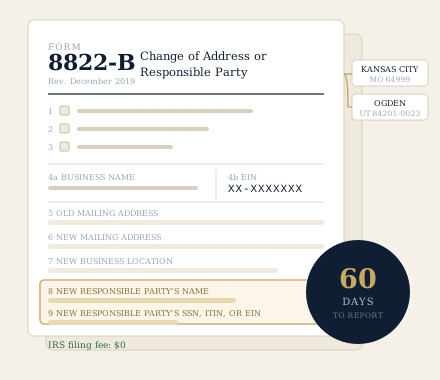
What is Form 8822-B?
Form 8822-B is the IRS form titled Change of Address or Responsible Party — Business. Any entity holding an EIN files it to update its mailing address, its business location, or its responsible party. The IRS charges $0.
The current revision is dated December 2019 and carries OMB number 1545-1163 and catalog number 57465H. The form occupies 1 page of fields and 1 page of instructions. The IRS estimates 18 minutes to complete and file it, which matches a form built from 10 short lines and 3 checkboxes.
The form exists because the IRS sends every consequential notice by mail to the address on the EIN account. A notice of deficiency, a notice of demand for tax, and a CP series notice all travel to that address. An EIN account carrying an address from 3 years ago receives none of them, while the deadlines inside those notices keep running.
Two instructions on the form change how you handle it. The first: do not attach Form 8822-B to a tax return. It travels alone in its own envelope, to its own address. The second: a person changing both a home address and a business address files Form 8822 for the home address and Form 8822-B for the business address. Two forms, two envelopes, two IRS records.
Who files Form 8822-B
Every entity holding an EIN files it: a corporation, a partnership, a single-member LLC, a multi-member LLC, a trust, an estate, and a nonprofit. The form applies whether or not the entity engages in a trade or business. A tax-exempt organization checks the box at the top of the form, which routes the change to the exempt organizations records described in Publication 557.
How do you fill out Form 8822-B line by line?
Check boxes 1 to 3, enter the business name and EIN on lines 4a and 4b, the addresses on lines 5 to 7, the responsible party on lines 8 and 9, and sign line 10.
The 10 lines split into 3 groups. Boxes 1 to 3 route the change. Lines 4a to 7 carry identification and addresses. Lines 8 to 10 carry the responsible party and the signature that makes the form valid.
Line 1: Employment, excise, income, and other business returns
Check box 1 when the change affects Form 720, Form 940, Form 941, Form 990, Form 1041, Form 1065, or Form 1120.
Box 1 covers the returns most entities file. Checking it routes the change to those filing records.
Line 2: Employee plan returns
Check box 2 when the change affects Form 5500 or Form 5500-EZ, the annual returns filed for an employee benefit plan.
A business with no retirement plan leaves box 2 blank. The IRS keeps plan records on a separate system.
Line 3: Business location
Check box 3 when the physical location of the business changed, whether or not the mailing address changed with it.
Mailing address and business location are separate fields. Box 3 pairs with line 7, not with line 6.
Line 4a: Business name
Enter the legal name the IRS holds for the EIN today. Line 4a identifies the entity; it does not change the name.
A name that reads differently from IRS records stalls the form. Match the CP-575 character for character.
Line 4b: Employer identification number
Enter the 9-digit EIN in the 2-digit and 7-digit format. Line 4b is the field the IRS uses to find the account.
One Form 8822-B covers one EIN. An owner holding 3 EINs files 3 separate forms.
Line 5: Old mailing address
Enter the mailing address the IRS holds now, including apartment, room, or suite number. Foreign addresses use the 3 fields below the line.
Line 5 also decides where the form goes. The Where To File table keys off the old business address.
Line 6: New mailing address
Enter the address where the IRS should send notices from now on. A P.O. box is allowed when the post office delivers no street mail.
Mail received through an accountant or attorney takes C/O, then the third party name and address.
Line 7: New business location
Enter the new physical location of the business. Line 7 stays blank when the business operates from the mailing address on line 6.
A foreign business location uses the country name, province or county, and postal code fields.
Line 8: New responsible party's name
Enter the name of the person who now owns, controls, or exercises effective control over the entity and its funds.
Line 8 carries the 60-day deadline. An address-only change leaves lines 8 and 9 blank.
Line 9: New responsible party's SSN, ITIN, or EIN
Enter the identifying number of the person named on line 8. The form accepts an SSN, an ITIN, or an EIN.
The form directs you to the Form SS-4 instructions for which number applies to which responsible party.
Line 10: Signature
An owner, officer, general partner, LLC member manager, plan administrator, fiduciary, or authorized representative signs under penalties of perjury.
A representative attaches Form 2848. The IRS completes no change requested by an unauthorized third party.
Source: IRS Form 8822-B (Rev. December 2019), lines 1 through 10, verified July 2026.
Three field rules decide whether the form clears. Include the apartment, room, or suite number in every address. Enter a P.O. box only when the post office delivers no mail to the street address. Enter a foreign address in the country’s own format, with the country name written out rather than abbreviated.
Line 4a causes more stalls than any other field, because it asks for the name the IRS already holds rather than the name the business uses. The IRS matches an EIN to a name control built from the first characters of the legal name, so LLC on one document and L.L.C. on another produce a mismatch. Read how that matching works on the IRS name control page, and confirm the name on file against your EIN confirmation letter.
Who is the responsible party on an EIN?
The responsible party is the person who owns, controls, or exercises effective control over the entity and directly or indirectly manages its funds and assets. Lines 8 and 9 of Form 8822-B record that person.
Control is the test, not title. A president who signs nothing and moves no money is not the responsible party. A sole member of an LLC who signs every bank instruction is, whatever the operating agreement calls the role. The IRS wants the human being who can direct the money.
A nominee cannot hold the role. A nominee is a person given temporary authority during formation with little or no control over the entity’s assets. The IRS states plainly that a nominee cannot apply for an EIN and should not appear on Form SS-4. An EIN account still listing one exposes the account to an unauthorized person, and Form 8822-B is the instrument that removes them.
| Entity | Responsible party | Number on line 9 |
|---|---|---|
| Single-member LLC | The member who controls the funds | SSN, ITIN, or EIN |
| Multi-member LLC | The member manager who controls the funds | SSN, ITIN, or EIN |
| Corporation | The officer with control over funds and assets | SSN, ITIN, or EIN |
| Partnership | The general partner with control | SSN, ITIN, or EIN |
| Trust | The trustee holding control of trust assets | SSN, ITIN, or EIN |
| Estate | The executor or personal representative | SSN, ITIN, or EIN |
| Nonprofit | The officer or director with control | SSN, ITIN, or EIN |
Source: IRS Form 8822-B line 9, the Form SS-4 instructions, and the IRS Responsible Parties and Nominees guidance, verified July 2026.
Line 9 accepts 3 identifying numbers: an SSN, an ITIN, or an EIN. That third option is the one people miss. A responsible party who holds neither an SSN nor an ITIN enters an EIN, so the change stays available to owners outside the United States. Read the full role on the EIN responsible party page.
When is Form 8822-B due?
A responsible party change is due within 60 days of the change. An address change carries no IRS deadline. The 60-day rule comes from Regulations section 301.6109-1(d)(2)(ii) and binds every entity holding an EIN.
The rule arrived through T.D. 9617, the final regulations published in Internal Revenue Bulletin 2013-23 on June 3, 2013. Before those regulations, an EIN account carried the name of a founder who left the company a decade earlier and nothing required a correction. The regulations closed that gap by making the update mandatory for a responsible party change, and mandatory means the 60 days run whether or not a notice ever arrives.
Count the 60 days from the date control actually moved, not from the date a document recorded it. A membership interest that transferred on the 3rd of a month starts the clock that day, even when the amended operating agreement is signed 5 weeks later. Mailing the form early costs $0 and removes the question.
| Event | Lines used | Deadline | Mandatory |
|---|---|---|---|
| An owner sells a controlling interest | 8 and 9 | 60 days | Yes |
| A trustee is replaced | 8 and 9 | 60 days | Yes |
| An executor takes over an estate | 8 and 9 | 60 days | Yes |
| A nominee is removed from the account | 8 and 9 | 60 days | Yes |
| The business moves office | 3, 6, and 7 | None | No |
| The mail forwarding address changes | 6 | None | No |
Source: Regulations section 301.6109-1(d)(2)(ii), T.D. 9617, Internal Revenue Bulletin 2013-23, June 3, 2013. Verified July 2026.
Where do you mail Form 8822-B?
Two IRS addresses exist, chosen by the old address on line 5. Entities in 23 states and the District of Columbia mail to Kansas City, MO 64999. The other 27 states and foreign entities mail to Ogden, UT 84201-0023.
The routing keys off line 5, the old address, not line 6. A business moving from Ohio to Texas mails to Kansas City, because Ohio sits in the Kansas City list. Reading the table off the new address sends the form to the wrong campus and adds weeks.
| If the old business address was in | Mail Form 8822-B to |
|---|---|
| Connecticut, Delaware, District of Columbia, Georgia, Illinois, Indiana, Kentucky, Maine, Maryland, Massachusetts, Michigan, New Hampshire, New Jersey, New York, North Carolina, Ohio, Pennsylvania, Rhode Island, South Carolina, Tennessee, Vermont, Virginia, West Virginia, Wisconsin | Internal Revenue Service Kansas City, MO 64999 |
| Alabama, Alaska, Arizona, Arkansas, California, Colorado, Florida, Hawaii, Idaho, Iowa, Kansas, Louisiana, Minnesota, Mississippi, Missouri, Montana, Nebraska, Nevada, New Mexico, North Dakota, Oklahoma, Oregon, South Dakota, Texas, Utah, Washington, Wyoming, and any place outside the United States | Internal Revenue Service Ogden, UT 84201-0023 |
Source: Where To File table, IRS Form 8822-B (Rev. December 2019). Verified July 2026.
The two lists cover 50 states plus the District of Columbia, and Ogden takes every address outside the United States. A founder operating a US entity from abroad therefore mails to Ogden regardless of where the entity was formed, because the old business address sits outside the country.
Form 8822-B carries no electronic filing route and no fax number. The Where To File table lists 2 mailing addresses and nothing else, and the form instructs you not to attach it to a return. Mail with a delivery receipt: the form generates no acknowledgement number, so the receipt is the only proof of the mailing date, and the mailing date is what the 60-day rule measures.
How long does Form 8822-B take to process?
The IRS takes 4 to 6 weeks to process an address or responsible party change filed on Form 8822-B. The 60-day reporting deadline measures the mailing, not the processing, so a form mailed on day 59 arrives on time.
The IRS confirms a responsible party change in writing. When no confirmation arrives inside 60 days, the IRS directs you to mail a second copy of the form marked Second Request. Marking it matters: an unmarked duplicate reads as a new filing and re-enters the same 4 to 6 week queue behind the first.
| Stage | Time | What produces it |
|---|---|---|
| Completing the form | 18 minutes | IRS estimated average completion time |
| Mail transit to the IRS campus | Days | Postal delivery to Kansas City or Ogden |
| IRS processing | 4 to 6 weeks | Stated on the Form 8822-B instructions |
| Written confirmation of a party change | Inside 60 days | IRS responsible party guidance |
| Second Request, when nothing arrives | A new 4 to 6 weeks | A second copy marked Second Request |
Source: IRS Form 8822-B instructions and IRS Responsible Parties and Nominees guidance, verified July 2026.
Nothing shortens the 4 to 6 weeks. No expedite service exists for Form 8822-B, and no fee buys one, because the IRS charges $0 for the change in the first place. A bank or platform needing proof before the change posts accepts the current 147C letter instead, which restates the EIN as the IRS holds it today.
Who can sign Form 8822-B?
An owner, an officer, a general partner, an LLC member manager, a plan administrator, a fiduciary, or an authorized representative signs line 10. An officer means a president, vice president, treasurer, or chief accounting officer.
The signature carries a penalties-of-perjury declaration, so the signer is attesting the form is true, correct, and complete. Line 10 also takes a daytime telephone number, which is optional and which gives the IRS a way to resolve a defect without restarting the 4 to 6 weeks.
A representative signing on behalf of the taxpayer must attach a power of attorney, and Form 2848 serves that purpose. The IRS states the rule bluntly: it will not complete an address or responsible party change from an unauthorized third party. An accountant who mails the form without an attached Form 2848 gets the form back rather than a confirmation.
The outgoing responsible party can sign it. Nothing in the form requires the new party’s signature, which matters in an ownership transfer where the departing owner controls the records. One signature from an authorized person is what line 10 asks for.
Can Form 8822-B change a business name?
No. Form 8822-B changes the mailing address, the business location, and the responsible party only. Line 4a records the current legal name for identification. A name change goes on the entity return or in a signed letter to the IRS.
The confusion is understandable, because line 4a is the first name field on the form. It is an identifier. The IRS reads it to locate the EIN account, exactly as it reads the 9 digits on line 4b. A new name typed into line 4a produces a mismatch against IRS records and stalls the whole form, including the address change you did want.
The route for a name change depends on entity type: a corporation checks the name-change box on Form 1120, a partnership checks it on Form 1065, and an LLC follows the return it files. An entity between filings sends a signed letter instead. Work through the exact procedure on the change business name with IRS page.
The EIN survives all of it. A name change keeps the same 9 digits, an address change keeps the same 9 digits, and a responsible party change keeps the same 9 digits. Verify what the IRS holds today with an EIN number lookup, and close an account you no longer need through the cancel ein procedure.
What happens if you never file Form 8822-B?
The IRS charges no penalty for failing to file Form 8822-B. The cost is missed mail: an entity with a stale address may not receive a notice of deficiency, while penalties and interest keep accruing.
Read that sentence twice, because it is the whole risk. Failure to receive a notice does not pause the notice. The IRS states that penalties and interest continue to accrue on any tax deficiencies despite the failure to receive the notices, and a notice of deficiency runs a response window from the date the IRS mails it to the last known address.
A notice of deficiency reaches a dead address. The IRS mails it to the address on the EIN account. The response window runs from the mailing date, and an unopened envelope changes none of it.
A refund check goes to the wrong building. The IRS mails paper refunds to the address on file. A check returned undelivered sits with the IRS until the entity files Form 8822-B and the change posts in 4 to 6 weeks.
An unauthorized person stays on the EIN account. A departed owner or a nominee left on lines 8 and 9 remains the person the IRS treats as the responsible party. The IRS warns that this exposes the account to an unauthorized person.
A bank verification fails against IRS records. A bank matches the EIN, the legal name, and the address against IRS records before opening an account. A stale address on a 147C letter is what fails the match.
The 60-day regulation stays breached. The obligation under Regulations section 301.6109-1(d)(2)(ii) does not expire at day 61. Filing late satisfies the requirement, and filing never leaves it open.
Source: Privacy Act and Paperwork Reduction Act Notice, IRS Form 8822-B (Rev. December 2019). Verified July 2026.
When do you need a new EIN instead of Form 8822-B?
A new EIN is required when the entity itself changes, not its details. A sole proprietorship that incorporates needs a new EIN. A single-member LLC that adds a member becomes a partnership and needs a new EIN. Form SS-4 applies.
The dividing line is entity identity. Form 8822-B updates facts about an entity that continues to exist: where it receives mail, where it operates, who controls it. A new EIN answers a different question, and the IRS asks it whenever a new legal entity comes into being or an existing one changes structure.
Three cases sit on the 8822-B side and surprise people. An ownership change of 100% of a corporation keeps the EIN, and the buyer files Form 8822-B within 60 days. A partnership that changes its partners without terminating keeps the EIN. A trust that replaces its trustee keeps the EIN. Work through every case in the matrix on the do i need a new ein page.
Applying without a Social Security Number
Form SS-4 line 7b accepts the word Foreign, so the IRS issues EINs to responsible parties who hold no SSN and no ITIN. The application moves from the online tool to fax. The IRS fax line is 855-641-6935 for entities based in a US state and 855-215-1627 for international applicants. The IRS international phone line is 267-941-1099. No identity document is filed with Form SS-4.
Have an SSN? irs.gov is free, and the online tool issues the EIN in 15 minutes.
No SSN? The fax route above is free, or we file it for $99 and deliver in 7 business days.
| Filed by | Price | Written deadline | Year 2+ |
|---|---|---|---|
| Yourself, direct to the IRS | $0 | None | $0 |
| ein-number.com | $99 | 7 business days or 100% automatic refund | $0 |
| Other filing services | $99 to $200 | None | $0 |
Other-service prices verified July 2026; the $200 figure is a no-SSN rate. Business days are Monday to Friday, excluding US federal holidays.
The IRS charges $0 for an EIN through every method, exactly as it charges $0 for Form 8822-B. The $99 covers preparation, filing within 1 business day of your completed details, IRS monitoring, and a delivery date in writing. You can get your EIN number in 7 business days or file it yourself for nothing.