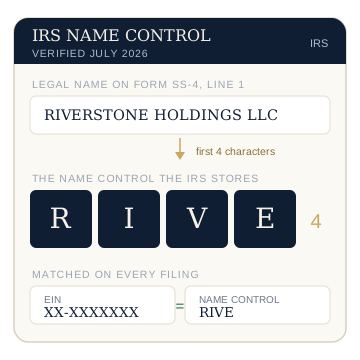
Where does the IRS get your name control?
The IRS builds it from line 1 of Form SS-4, the legal name of the entity. It never builds it from line 2, the trade name. That single choice explains most rejections.
Form SS-4 asks for 2 names in the first 2 lines. Line 1 is the legal name of the entity applying. Line 2 is the trade name, the dba, the brand on the invoice. The IRS records both and derives the name control from line 1 alone.
A business owner who writes the brand on line 1 and the legal name on line 2 receives a valid EIN with a name control built from the brand. Every filing after that has to carry the brand characters, not the legal ones. The EIN works. The pairing surprises the accountant at the first return, when the 4 characters have to match what the IRS stored rather than what the letterhead says.
The person who signs Form SS-4 also matters, and that person is a separate field from the entity name. Read who holds that role on the EIN responsible party page, and read the full application walkthrough on the how to apply for an EIN page.
Which characters does a name control allow?
A name control accepts 38 characters: 26 letters, 10 digits, the hyphen, and the ampersand. Every other character drops out of the name before the first 4 are counted.
The rule runs in 2 steps, and the order decides the answer. Step 1 removes every disallowed character from the legal name. Step 2 takes the first 4 characters of what remains. A person who reverses the steps derives the wrong code every time an apostrophe or a period sits inside the first 4 positions.
| Character | Status | Effect on the 4 characters | Example |
|---|---|---|---|
| Letters A to Z | Kept | Counted in position, uppercase | Riverstone → RIVE |
| Digits 0 to 9 | Kept | Counted in position | 7th Street → 7THS |
| Hyphen | Kept | Counted as 1 character | A-1 Freight → A-1F |
| Ampersand | Kept | Counted as 1 character | A & B Machining → A&BM |
| Apostrophe | Dropped | Later letters move forward | O'Hara → OHAR |
| Period | Dropped | Later letters move forward | P.R.S. Systems → PRSS |
| Comma | Dropped | Later letters move forward | Vega, Lopez → VEGA |
| Slash and other symbols | Dropped | Later letters move forward | S/T Marine → STMA |
| Blank space | Dropped inside | Kept only as trailing padding | Kim Inc → KIM |
Source: IRS name control guidance for business filers, verified July 2026.
Two more rules sit on top of the character set. A name control shorter than 4 characters is left-justified and padded with blanks, so Kim Inc becomes 3 characters and 1 blank. The word The drops when 2 or more words follow it, and stays when exactly 1 word follows it.
What is the name control rule for each entity type?
Ten rules cover the entity types. A corporation and an LLC read from the entity name. A partnership without a trade name, a sole proprietor, a trust, and an estate read from a person's last name.
The split matters more than the arithmetic. Four of the 10 rules point at a human being rather than at the business, so the name printed on the sign has nothing to do with the code. An estate named for a deceased individual and a trust named for a living one both resolve to that person's last name.
| Entity | The IRS reads | Example legal name | Control |
|---|---|---|---|
| Corporation | The first 4 characters of the corporate name on the EIN application. | Riverstone Holdings Inc | RIVE |
| Corporation named for a person | The first 4 characters of the corporate name, first name first, exactly as written. | Ann M Reeves Inc | ANNM |
| Partnership with a trade name | The first 4 characters of the trade name the partnership registered. | Bluewater Trading Partners | BLUE |
| Partnership with no trade name | The first 4 characters of the last name of the first partner listed. | Kimura and Alvarez, general partnership | KIMU |
| Sole proprietor | The first 4 characters of the individual's last name, not the business name. | Marcus Okonkwo, dba Northline Design | OKON |
| LLC filing as a corporation | The first 4 characters of the LLC name on the EIN application. | Northline Design LLC | NORT |
| LLC filing as a partnership | The first 4 characters of the LLC name on the EIN application. | Kimura Alvarez LLC | KIMU |
| Trust | The first 4 characters of the last name of the individual the trust is named for. | Jonathan Periwinkle Family Trust | PERI |
| Estate | The first 4 characters of the last name of the deceased individual. | Estate of Helena Vasquez | VASQ |
| Tax-exempt organization | The first 4 characters of the organization name on the exemption record. | The Willow Fund | WILL |
Source: IRS name control guidance by entity type, verified July 2026.
A single-member LLC creates the one real ambiguity. An LLC that applied under its own name carries the LLC characters. An LLC whose owner applied under a personal name carries the owner's last name. The CP-575 settles it, because it prints the legal name the IRS actually recorded.
Work the entity rules through in full on the EIN for an LLC page, the EIN for a trust page, and the EIN for an estate page.
How does a name control derive from a legal name?
Remove every character outside the 38 allowed, then take the first 4 that remain. The 12 worked examples below show how a hyphen survives and an apostrophe disappears.
| Legal name | Name control | Why |
|---|---|---|
| Riverstone Holdings LLC | RIVE | The first 4 letters carry straight across. |
| The Willow Fund | WILL | The word The drops when 2 or more words follow it. |
| The Cabin | THEC | The word The stays when exactly 1 word follows it. |
| 7th Street Coffee Inc | 7THS | Digits count as characters and hold their position. |
| A & B Machining Co | A&BM | The ampersand is kept and the blanks around it drop. |
| O'Hara Logistics Inc | OHAR | The apostrophe drops and the next letter moves up. |
| Vega-Lopez Imports LLC | VEGA | The hyphen is kept, so it counts only when it falls inside the first 4. |
| P.R.S. Systems Inc | PRSS | Periods drop, so the letters close ranks. |
| Kim Inc | KIM | A name shorter than 4 characters is left-justified and padded with blanks. |
| Estate of Helena Vasquez | VASQ | An estate reads from the last name of the deceased individual. |
| Jonathan Periwinkle Family Trust | PERI | A trust reads from the last name it is named for. |
| Marcus Okonkwo, dba Northline Design | OKON | A sole proprietor reads from the last name, never the dba. |
Source: IRS name control derivation rules, verified July 2026. Names are illustrative.
Read the pattern across the 12 rows and 3 traps appear. A dropped character pulls a later letter into the first 4, so O’Hara loses nothing visible and still shifts. A kept character occupies a slot, so A & B Machining spends 2 of its 4 positions on a symbol and a single letter. A short name pads rather than borrowing from the next word, so Kim Inc never becomes KIMI.
Why does a filing reject on a name control mismatch?
The 4 characters transmitted with the return disagree with the 4 characters the IRS holds for that EIN. The IRS compares them before it reads the return, so nothing inside the return is processed.
The comparison is exact and positional. A control of RIVE against a stored RIVR fails on 1 character out of 4. The system reports a mismatch rather than a near miss, because a 75% match carries no meaning when the purpose of the field is to prove identity.
| Cause | What went in | What the IRS holds | Fix |
|---|---|---|---|
| Legal name changed, never filed | NORT (new name) | RIVE (old name) | File Form 8822-B, then refile |
| Trade name used instead of legal name | NORT (the dba) | OKON (the owner) | Use the CP-575 legal name |
| Special character handled wrong | OHAR entered as O'HA | OHAR | Drop the apostrophe first |
| Wrong entity rule applied | TRUS (the word trust) | PERI (the person) | Apply the trust rule |
| EIN mistyped by 1 digit | Correct 4 characters | A different entity entirely | Recheck the 9 digits |
| Software auto-filled the brand | The marketing name | The formation-document name | Overwrite the field |
Source: IRS business e-file name control matching rules, verified July 2026.
A rejected EIN application carries its own numbered reference codes, which is a separate failure from a name control mismatch on a return. Read those on the EIN reference number 101 page.
How do you find your IRS name control?
Derive it from the legal name on your CP-575. The IRS confirms it by phone, and a 147C letter prints the legal name of record. All 3 routes cost $0, and no public database lists name controls.
Start with the document rather than the memory. The CP-575 records the exact legal name the IRS paired with the EIN at assignment, spelling and punctuation included. Applying the entity rule to that string produces the stored code in under 1 minute.
| Route | What it gives you | Time | Cost |
|---|---|---|---|
| Read the CP-575 and apply the entity rule | The legal name of record | 1 minute | $0 |
| Read a prior accepted federal return | The name control that already passed | 2 minutes | $0 |
| Call the IRS Business and Specialty Tax Line | Confirmation against IRS records | One call | $0 |
| Call the IRS international line, 267-941-1099 | Confirmation from outside the US | One call | $0 |
| Request a 147C letter | The legal name reissued in writing | Days to weeks | $0 |
Source: IRS, verified July 2026.
A prior accepted return is the strongest evidence available outside the IRS itself. The IRS matched that filing before it processed it, so the 4 characters on an accepted return are the 4 characters on file. Read the anatomy of the assignment document on the CP-575 page, the reissue procedure on the 147C letter page, and every recovery route on the EIN number lookup page.
How do you fix a name control mismatch?
Confirm the legal name of record first, then correct the filing to match it. When the legal name itself is outdated, file Form 8822-B and refile after the IRS posts the change. Each step costs $0.
The order is the whole fix. Correcting the return before confirming the record produces a second guess and a second rejection. Confirming the record first turns the problem into a 1-field edit.
Step 1: pull the CP-575 or an accepted return. Read the legal name character by character. A comma between a name and a suffix changes nothing, and a missing apostrophe changes everything.
Step 2: apply the entity rule for your structure. Use the row from the 10-rule table above. A trust and a sole proprietor read from a person's last name, not from the business name on the letterhead.
Step 3: confirm with the IRS when 2 derivations disagree. The IRS confirms the stored code by phone at no charge. International filers reach the IRS at 267-941-1099.
Step 4: correct the field and retransmit. A name control mismatch stops the filing before processing, so a corrected retransmission is treated as the filing rather than as an amendment.
Step 5: file Form 8822-B when the name itself changed. Form 8822-B updates the legal name and the responsible party in IRS records. The 9-digit EIN never changes with the name.
Nothing in this sequence requires a new EIN. A mismatch is a records problem, and the number survives it. See which events do force a new number on the do I need a new EIN page.
Does a business name change change the name control?
Yes, when the legal name changes. New first 4 characters produce a new code. The 9-digit EIN stays the same, and Form 8822-B records the change with the IRS.
A trade name change moves nothing. An owner who rebrands from Northline Design to Harbour Studio while the formation document still reads Riverstone Holdings LLC keeps the code RIVE. The IRS reads line 1, and line 1 did not move.
A legal name change moves everything, and it moves on the IRS timetable rather than the state one. The state amendment takes effect on the day the state says. The IRS record changes when the IRS posts Form 8822-B. Between those 2 dates, filings match against the old 4 characters.
| Change | New name control | New EIN | Form to file |
|---|---|---|---|
| Legal name amended with the state | Yes | No | Form 8822-B |
| Trade name or dba changed | No | No | None |
| Business address changed | No | No | Form 8822-B |
| Responsible party changed | No | No | Form 8822-B, within 60 days |
| Sole proprietorship incorporates | Yes | Yes | Form SS-4 |
| Single-member LLC adds a second member | No | Yes | Form SS-4 |
Source: IRS Form 8822-B instructions and IRS EIN guidance, verified July 2026.
File the update on the Form 8822-B page, and read the keep-the-same-EIN answer on the when do you need a new EIN page.
Do banks and platforms check the name control?
Banks and payment platforms check the EIN against the legal name, which is the same match the name control encodes. A W-9 that carries a brand instead of the legal name fails that check.
The verification runs on the pairing, not on the number alone. A 9-digit EIN that passes a format test and fails a name match produces the account-opening rejection that reads as unexplained. The CP-575 ends that loop, because it prints both halves of the pair on 1 page.
Line 1 of Form W-9 asks for the name shown on the income tax return, and line 2 asks for the business name or dba. That ordering mirrors Form SS-4 exactly. A contractor who reverses the 2 lines creates a mismatch that the paying company discovers at the 1099 stage, months after the work finished.
See what each institution asks for on the ein verification requirements banks platforms page, and read the plain-language definitions in the ein glossary of terms.
When does a name control problem require a new EIN?
A mismatch never requires a new EIN. A new EIN is required when the entity itself changes, and the new entity receives its own legal name and its own 4-character code. The IRS charges $0.
Two situations are confused with each other constantly. Correcting 4 characters on a filing is a records fix. Forming a new entity is a new taxpayer, and a new taxpayer receives a new number.
Applying without a Social Security Number
Form SS-4 line 7b accepts the word Foreign, so the IRS issues EINs to responsible parties who hold no SSN and no ITIN. The application moves from the online tool to fax. The IRS fax line is 855-641-6935 for entities based in a US state and 855-215-1627 for international applicants. No identity document is filed with Form SS-4, and the name control derives from line 1 the same way it does for anyone else.
Have an SSN? irs.gov is free, and the online tool issues the EIN in 15 minutes.
Read the complete no-SSN chapter on the EIN without an SSN page.
| Filed by | Price | Written deadline | Year 2+ |
|---|---|---|---|
| Yourself, direct to the IRS | $0 | None | $0 |
| ein-number.com | $99 | 7 business days or 100% automatic refund | $0 |
| Northwest | $200 | None | $0 |
| ZenBusiness | $99 | None | $0 |
Competitor prices verified July 2026. Northwest reflects the no-SSN rate. Business days are Monday to Friday, excluding US federal holidays.
The IRS charges $0 for an EIN through every method. The $99 covers preparation, a legal name checked against your formation document before it reaches line 1, filing within 1 business day of your completed details, IRS monitoring, and a delivery date in writing. You can get started or file it yourself for nothing.