Which estates need an EIN?
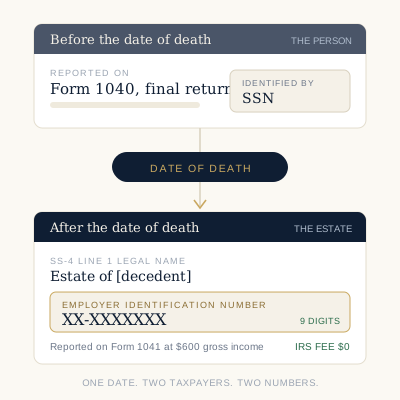
Every estate that receives income, opens an account, or files a return needs an EIN. The estate is a separate taxable entity from the date of death, and no bank opens an estate account against a decedent’s SSN.
The practical test is not the size of the estate. It is whether anything at all has to be done in the estate’s own name. Three events force the number: an account, a return, and a payer that reports.
The estate opens a bank or brokerage account. A bank verifies the EIN against the CP-575 before opening an estate account. The decedent's SSN is closed to new accounts from the date of death, so no substitute exists.
The estate has $600 or more of gross income. Form 1041 becomes mandatory at $600 of gross income in a tax year, and the return has no field for a Social Security Number in place of an estate EIN.
A beneficiary is a nonresident alien. A single nonresident alien beneficiary makes Form 1041 mandatory at $0 of income, so the $600 test stops applying entirely.
A payer has to issue a Form 1099 to the estate. Interest, dividends, rent, and sale proceeds paid after the date of death are reported to the estate. The payer needs a 9-digit number to put on the form.
The estate continues a business or pays wages. Payroll filings run under an employer EIN. An estate that keeps paying employees files Form 941 under its own number from the first payroll after death.
The estate sells real property. A title company reports the sale on Form 1099-S against the selling taxpayer. After the date of death the seller is the estate, identified by its EIN.
Source: IRS Form 1041 and Form SS-4 instructions, verified July 2026.
An estate that holds nothing but jointly titled property passing outside probate reaches none of those 6 triggers. That is the one common case where no estate EIN is opened at all.
When must an estate file Form 1041?
An estate files Form 1041 for any tax year with gross income of $600 or more, or with any beneficiary who is a nonresident alien. The test measures gross income, not net profit.
Gross income is the word that decides most cases. An estate that sells a house for $400,000 against a $385,000 basis reports a $15,000 gain, and $2,000 of interest on top of it, so the threshold is cleared many times over before a single deduction is counted. Deductions reduce the tax owed, and they do not remove the obligation to file.
The $600 test is applied per tax year, not once for the whole administration. An estate that stays open for 3 years runs the test 3 times, and a year that falls under $600 with no nonresident alien beneficiary carries no Form 1041.
| Estate receives | Counts toward the $600 | Form 1041 required |
|---|---|---|
| $540 of savings interest, no other income | Yes, gross income $540 | No |
| $540 of interest, 1 nonresident alien beneficiary | The test stops applying | Yes |
| $700 of dividends | Yes, gross income $700 | Yes |
| $310,000 house sale, $4,000 gain over basis | Yes, gross income $4,000 | Yes |
| A $250,000 life insurance payout to a named beneficiary | No, it bypasses the estate | No |
| $0 income, estate open 14 months | Gross income $0 | No |
Source: IRS Instructions for Form 1041, verified July 2026. Figures are worked examples.
Can an estate choose its own tax year?
Yes. An estate elects a fiscal year ending on the last day of any month, provided the first tax year runs no longer than 12 months from the date of death. Form SS-4 line 12 records the closing month.
This is the single most consequential entry on an estate’s SS-4, and it is made before most executors know what the estate will earn. The closing month sets every Form 1041 due date for the life of the estate, and changing it afterwards means asking the IRS for permission.
A death on 12 March 2026 gives a maximum first year ending 28 February 2027. The executor picks any month-end inside that window: 31 March 2026 for a 19-day first year, 30 June 2026 for a 3-month first year, or 31 December 2026 for a calendar year. A short first year is deliberate when the estate wants an early first return on record.
The fiscal year is also the lever that moves income between beneficiaries’ personal tax years. A beneficiary reports estate income on their own return for the year in which the estate’s tax year ends, so a 30 June year end pushes that income into the beneficiary’s following calendar year.
Source: IRS Instructions for Form 1041 and Form SS-4, verified July 2026.
When is each estate deadline?
Form 1041 is due the 15th day of the 4th month after the tax year ends. Form 706 is due 9 months after the date of death. Form 56 is filed as soon as the fiduciary is appointed.
| Form | What it does | Due | Extension |
|---|---|---|---|
| Form SS-4 | Applies for the estate EIN | Before the first account or return | None, it is not a deadline filing |
| Form 56 | Notifies the IRS of the fiduciary relationship | On appointment of the fiduciary | None |
| Form 1040, final | Reports the decedent's income to the date of death | 15 April of the year after death | Form 4868, 6 months |
| Form 1041 | Reports estate income after the date of death | 15th day of the 4th month after the tax year ends | Form 7004, 5.5 months |
| Form 706 | Reports the taxable estate | 9 months after the date of death | Form 4768, 6 months |
| Schedule K-1 (1041) | Reports each beneficiary's share | With the Form 1041 | Follows the Form 1041 extension |
Source: IRS form instructions, verified July 2026.
Read the table from the bottom up when time is short. The Form 706 clock is the only one that starts at the date of death rather than at a year end, so an estate large enough to file one has 9 months from a date nobody chose. Every other deadline moves with the closing month on SS-4 line 12.
An extension of time to file is not an extension of time to pay. Form 7004 moves the Form 1041 filing date by 5.5 months and leaves the payment date where it was.
Which Form SS-4 lines change for an estate?
Seven lines answer differently: line 1 reads Estate of the decedent, line 3 names the executor, line 9a is checked Estate with the decedent’s SSN, and line 11 carries the date of death.
An estate application fails on the same lines every time, because the form was written around operating businesses and an estate answers 7 of its questions in a way no business would.
| Line | Label on the form | What an estate enters |
|---|---|---|
| Line 1 | Legal name of entity | Estate of [the decedent's full legal name] |
| Line 3 | Executor, administrator, trustee | The name of the appointed fiduciary |
| Line 7a and 7b | Responsible party and their ID | The executor's name, then their SSN, ITIN, or the entry Foreign |
| Line 9a | Type of entity | Estate, with the decedent's SSN written in the box beside it |
| Line 11 | Date business started or acquired | The date of death |
| Line 12 | Closing month of accounting year | December, or any month within 12 months of the date of death |
| Line 16 | Principal activity | Other, described as estate administration |
Source: IRS Instructions for Form SS-4, verified July 2026.
Line 1: Legal name of entity
The IRS builds the name control from the first 4 characters of the surname, so the surname carries the match, not the word Estate.
Line 3: Executor, administrator, trustee
Line 3 exists for estates and trusts. It records who acts for the entity, which is a different question from who signs the form.
Line 7a and 7b: Responsible party and their ID
Line 7b accepts the word Foreign, so an executor holding no US identity number still applies.
Line 9a: Type of entity
The decedent's SSN identifies which person the estate follows. It never becomes the estate's own number.
Line 11: Date business started or acquired
The estate comes into existence on the date of death, so that date opens the estate's first tax year.
Line 12: Closing month of accounting year
This one entry fixes the fiscal year and every Form 1041 due date that follows from it.
Line 16: Principal activity
An estate runs no trade or business by default. The description keeps the classification consistent with Form 1041.
The full line-by-line walk-through for every entity type sits on the how to apply for an ein page.
How does an executor without an SSN get the estate EIN?
Form SS-4 line 7b accepts the entry Foreign, so an executor holding no SSN and no ITIN still applies. The route moves from the online tool to fax: 855-215-1627 international, 855-641-6935 for US-based entities.
The online EIN tool requires an SSN or ITIN from the responsible party, and it runs Monday to Friday, 7 a.m. to 10 p.m. Eastern. That single requirement is what sends a foreign executor to fax. Nothing about the estate itself changes, and no identity document is filed with Form SS-4.
This case is more common than the form suggests. A US citizen dies holding US property while the named executor lives abroad, or the surviving family emigrated decades earlier. The IRS issues the estate EIN in both situations, and the international phone line is 267-941-1099.
Have an SSN? irs.gov is free, and the online tool issues the estate EIN in 15 minutes.
No SSN? The fax route works, or we file it for you at $99 with a written 7-business-day deadline.
Source: IRS Form SS-4 instructions and IRS contact pages, verified July 2026.
How does the estate EIN follow the money to beneficiaries?
Income the estate distributes is deducted on Form 1041 and reported to each beneficiary on a Schedule K-1. The estate pays tax on what it keeps, and beneficiaries pay tax on what they receive.
An estate is a conduit, not a wall. The income distribution deduction moves the tax liability with the cash, which matters because estate tax brackets compress fast and reach the top rate on a far smaller amount of income than an individual’s do.
Two timing tools sit on top of that. The 65-day rule under section 663(b) lets a fiduciary treat a distribution made in the first 65 days of a tax year as made on the last day of the prior year. Combined with the fiscal year election on SS-4 line 12, those 2 levers decide which tax year each beneficiary reports the income in.
Estimated tax is the third piece. An estate is exempt from estimated tax payments for any tax year ending before the date 2 years after the death. After that 2-year window, the estate pays like an individual, in 4 instalments.
Source: IRS Instructions for Form 1041 and Internal Revenue Code sections 663(b) and 6654(l), verified July 2026.
How does an estate EIN differ from a trust EIN?
An estate elects a fiscal year and is exempt from estimated tax for 2 years after the death. A trust uses the calendar year and pays estimated tax from the start. Both file Form 1041.
The numbers look identical, because both are 9 digits issued on Form SS-4 at $0. The differences sit in what each number is allowed to do afterwards.
| Question | Estate | Trust |
|---|---|---|
| SS-4 line 9a entry | Estate | Trust |
| Tax year | Calendar or fiscal, up to 12 months | Calendar year |
| Income tax return | Form 1041 | Form 1041 |
| Estimated tax | Exempt for 2 years after the death | Due from the first year |
| Starts on | The date of death | The date the trust is funded |
| Ends on | Completion of administration | The terms of the trust document |
| Combining the 2 | Section 645 election on Form 8855 | Section 645 election on Form 8855 |
Source: IRS Instructions for Form 1041 and Form 8855, verified July 2026.
The section 645 election is the bridge between the 2 rows. A qualified revocable trust and the related estate are treated as 1 entity and file a single Form 1041 under the estate’s EIN, which is how a trust borrows the estate’s fiscal year for a set period. The entity chapter for trusts sits on the ein for trust page, and the one-owner comparison sits on the ein for sole proprietorship page.
Which estate EIN mistakes cost the most time?
Five recur: a name that omits the decedent, the decedent’s SSN entered on line 7b, a missing date of death on line 11, a closing month chosen at random, and a second application for an EIN that already exists.
Line 1 names the wrong party. The legal name is Estate of the decedent, not the executor's own name and not the family surname alone. The IRS builds a name control from the first 4 characters of the surname, and a mismatch stops the bank later.
The decedent's SSN goes on line 7b. Line 7b belongs to the living responsible party, the executor. The decedent's SSN goes in the box beside the Estate entry on line 9a, and putting it in both places is the most common estate rejection.
Line 11 is left blank or filled with today's date. An estate starts on the date of death, so line 11 carries that date. A current date opens the first tax year in the wrong place and moves every Form 1041 due date with it.
Line 12 is answered December by reflex. December is a valid answer and a choice, not a default. A fiscal year ending up to 12 months after the death is available once, on this line, and reversing it later requires IRS consent.
A second EIN is requested for the same estate. One estate holds 1 EIN for its whole administration. A lost number is recovered with a 147C letter rather than a new application, and the IRS limits an applicant to 1 EIN per responsible party per day.
A rejection returns as a numbered reference code, and the meaning of each code is set out on the ein reference number 101 page. A number that was issued and then lost is recovered through the 147C letter route.
How does an estate EIN end?
The fiduciary files a final Form 1041 with the final return box checked, then mails a letter with the EIN and legal name to Internal Revenue Service, Cincinnati, OH 45999 to close the account.
The final year carries 2 rules the earlier years do not. All income is treated as distributed to the beneficiaries, and excess deductions that the estate cannot use pass through to them on Schedule K-1 under section 642(h). A final return filed carelessly discards deductions that belong to the family.
Closing the IRS account is separate from filing the final return. The number itself is never reassigned to another taxpayer, and it never renews, so the year-2 cost of an estate EIN is $0 whether the account is closed or left open.
The full closing procedure, including what the letter has to contain, sits on the cancel EIN page, and the situations that force a brand new number are set out on the do i need a new ein page.
Source: IRS Instructions for Form 1041 and IRS guidance on closing a business account, verified July 2026.
What does an EIN for an estate cost?
The IRS charges $0 for an estate EIN through every method, and the number never renews, so year 2 costs $0. A filing service charges for preparation and a delivery commitment, not for the number.
| Filed by | Price | Written deadline | Year 2+ |
|---|---|---|---|
| Yourself, direct to the IRS | $0 | None | $0 |
| ein-number.com | $99 | 7 business days or 100% automatic refund | $0 |
| Northwest | $200 | None | $0 |
| ZenBusiness | $99 | None | $0 |
| Rocket Lawyer | $59.99 | None | $0 |
Competitor prices verified July 2026. Northwest reflects the no-SSN rate. Business days are Monday to Friday, excluding US federal holidays.
The $99 covers preparation of Form SS-4 checked against the death certificate and the letters of appointment, filing within 1 business day of your completed details, IRS monitoring across 4 tracked stages, and a delivery date in writing. The deliverables are the 9-digit EIN and the official IRS CP-575 letter, which is the document a bank asks for when it opens the estate account. You can get started or file it yourself for nothing. The full price breakdown sits on the EIN cost page.