What is the rule behind every new EIN answer?
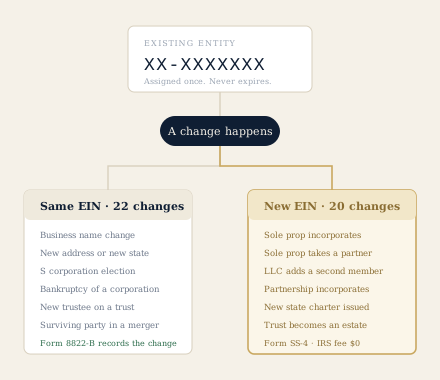
The IRS assigns one EIN per entity, for the life of that entity. A new EIN follows a new entity, not a new label. Ask one question: does a different legal entity exist after the change?
Every one of the 42 outcomes on this page comes from that single rule. A sole proprietorship that incorporates produces a corporation, and the corporation is a separate legal person from the individual. A corporation that renames itself produces the same corporation with a different name on the door.
Federal classification carries the same weight as state formation. A single-member LLC files as a disregarded entity. Adding a second member turns it into a partnership that files Form 1065, and the IRS treats that as a different taxpayer. State law records no new company, and the federal change alone requires the new number.
Three facts hold in every case. The EIN never expires. The IRS never reassigns a retired EIN to a different taxpayer. The old number stays attached to the old entity, including its filing history and any open balance. Read what the 9 digits represent on the EIN number lookup page.
| What changed | Is it a new entity | Result |
|---|---|---|
| The legal structure | Yes | New EIN |
| The state charter | Yes | New EIN |
| The federal classification | Yes | New EIN |
| The name | No | Same EIN |
| The address | No | Same EIN |
| The owners | No | Same EIN |
| The tax election | No | Same EIN |
Source: IRS, verified July 2026.
Does a sole proprietor need a new EIN?
A sole proprietor needs a new EIN in 4 cases: incorporating, taking in a partner, buying or inheriting a business, and a personal bankruptcy proceeding. A name change, a move, and a second business keep the existing number.
The sole proprietorship is the only entity type where the EIN ties to a human being rather than to a filed company. That explains the buying rule. Purchasing an existing business does not let you inherit its EIN, because the number belongs to the seller, and it explains the bankruptcy rule that no other entity type carries.
Running 3 separate businesses under one sole proprietorship needs 1 EIN, because 1 taxpayer exists. Compare the number a sole proprietor reports under on the EIN vs SSN page.
Does an LLC need a new EIN?
An LLC needs a new EIN in 3 cases: a new multi-member LLC forms, a new single-member LLC elects corporation treatment, or that LLC carries an employment or excise tax filing requirement. 5 other LLC changes keep the number.
The LLC rules read as the hardest set because state law and federal law disagree about what an LLC is. A state records one company. The IRS records a partnership, a corporation, or a disregarded entity, depending on member count and election. The EIN follows the federal answer.
Two cases produce opposite results from the same words. An LLC that already holds an EIN and then elects corporation treatment keeps its number, because the entity existed first. A brand-new single-member LLC that elects corporation treatment at formation takes a new number, because the election and the entity arrive together.
A single-member LLC that hires its first employee crosses the employment tax line and needs its own EIN rather than the owner Social Security Number. Read the entity comparison on the EIN vs TIN page.
Does a corporation need a new EIN?
A corporation needs a new EIN in 4 cases: a new state charter, becoming a subsidiary, changing to a partnership or sole proprietorship, and a new corporation formed by statutory merger. 7 corporate changes keep the existing number.
The state charter is the test for a corporation. A charter creates the legal person, so a second charter creates a second legal person that needs its own EIN. Reincorporating in a different state issues a new charter and requires a new number, while a state-level conversion that leaves the structure unchanged does not.
Mergers split on which entity survives. The survivor keeps its EIN and absorbs the other filing history. A statutory merger that produces a third, newly chartered corporation gives that corporation its own EIN. A division inside a corporation files under the corporate EIN, because a division holds no charter of its own.
Does a partnership need a new EIN?
A partnership needs a new EIN in 3 cases: it incorporates, one partner takes over and runs it as a sole proprietorship, or the partners end the old partnership and begin a new one. 4 partnership changes keep the number.
Ownership churn changes nothing. A transfer of 50 percent or more of the capital and profits interests inside 12 months keeps the same EIN, because the partnership continues as the same entity with different names on the ledger. Adding a fourth partner to a 3-partner firm keeps the number for the same reason.
One partner buying out the others crosses the line. A partnership requires 2 members, so a single surviving owner produces a sole proprietorship or a single-member LLC, and that new classification takes its own EIN.
Do trusts and estates need a new EIN?
A trust needs a new EIN in 4 cases and an estate in 2. Each separate trust one grantor creates takes its own EIN. A trustee change, a beneficiary name change, and an executor change all keep the existing number.
Trusts and estates are the entity types where a single event creates several taxpayers at once. A grantor who funds 3 separate trusts creates 3 EINs. A living trust that terminates by distributing property into a residual trust ends 1 taxpayer and starts another.
The estate rules turn on what the estate does. An estate that simply holds and distributes assets uses 1 EIN. An estate that keeps operating the business of the deceased owner after death needs its own EIN for that business activity, separate from the personal representative.
Ending the filing obligation on an EIN that no longer has an entity behind it is a separate procedure. Read it on the cancel ein page.
Which changes never require a new EIN?
22 changes keep the existing EIN. Name changes, address changes, new locations, new owners, new officers, new trustees, tax elections, and bankruptcy for a corporation or partnership all leave the 9 digits untouched.
| Entity type | Triggers a new EIN | Keeps the EIN | The decisive test |
|---|---|---|---|
| Sole proprietorship | 4 | 3 | Does a filed entity now exist |
| Limited liability company | 3 | 5 | Member count and tax election at formation |
| Corporation | 4 | 7 | Does a new state charter exist |
| Partnership | 3 | 4 | Does the partnership itself continue |
| Trust | 4 | 2 | Is a separate trust created |
| Estate | 2 | 1 | Does the estate operate a business |
| All 6 entity types | 20 | 22 | Does a different entity exist |
Source: IRS guidance on entity changes, verified July 2026.
Does a business name change require a new EIN?
No. A name change keeps the same EIN for all 6 entity types. The IRS pairs the EIN with the entity, and a rename updates the record rather than the number. The business reports the new name to the IRS.
The reporting route depends on the return the entity files. A corporation checks the name-change box on page 1 of Form 1120. A partnership checks the same box on Form 1065. A sole proprietor sends a signed written notice to the address where the last return was filed.
The consequence of skipping that notice appears later, at a bank. The IRS matches an EIN against a name control built from the first 4 characters of the legal name. A stale name on file breaks that match and produces a rejection that looks like a wrong EIN. Read the address and responsible-party procedure on the form 8822-b page.
A DBA carries no EIN of its own. One entity operating 4 trade names holds 1 EIN, because the trade names describe the same taxpayer.
Does an ownership or responsible-party change require a new EIN?
No, as long as the entity type stays the same. Selling shares, replacing an officer, and naming a new responsible party keep the existing EIN. The IRS requires Form 8822-B inside 60 days of a responsible-party change.
The 60-day deadline is the part owners miss. The responsible party is the person who controls or directs the entity and its assets, and the IRS holds that name on file for correspondence. An outdated responsible party leaves IRS notices going to a person who left the business.
Two ownership events break the pattern. A sole proprietor who buys an existing business applies for a new EIN, because the buyer is a different taxpayer from the seller. A corporation that becomes a subsidiary of another corporation takes a new EIN rather than filing under the parent number.
A change of ownership never moves an EIN between people. The number stays with the entity. If the buyer purchases the company itself rather than its assets, the entity survives and its EIN survives with it.
What happens if you applied for a second EIN by mistake?
The IRS keeps both numbers assigned to you and never deletes either one. You use the correct EIN on every return and close the business account behind the unused number by letter. The fee is $0.
Duplicate EINs come from 3 situations: a second application filed after a first one appeared to fail, a formation service filing on top of an owner who already applied, and an entity change where the owner applied without needing to. The IRS treats each assignment as final.
Decide which EIN the entity actually uses. The EIN that appears on filed returns and on the bank account is the operating number. Changing that number later means amending every return that carried it.
Close the business account behind the unused EIN. A letter to the IRS carrying the legal name, the 9-digit EIN, the business address, and the reason ends the filing obligation on the duplicate.
File any return that the unused EIN already triggered. The IRS closes an account after every required return is filed. An EIN that never filed anything closes on the letter alone.
Correct the number with anyone holding the wrong one. A bank, a payroll provider, and a marketplace each verify the EIN against the legal name. One stale record produces a rejected verification months later.
An owner who cannot find which of 2 numbers the IRS holds against the current legal name requests a 147C letter. Work through recovery on the lost EIN number page, and read the request script on the 147C letter page.
How do you get a new EIN without a Social Security Number?
File Form SS-4 by fax. Line 7b accepts the entry Foreign for a responsible party who holds no SSN and no ITIN. The IRS fax line is 855-641-6935 for US-based entities and 855-215-1627 for international applicants.
The online IRS tool requires an SSN or ITIN, and it is the only route that does. Every rule on this page about which changes require a new EIN applies identically to a responsible party without an SSN. The entity test does not change with the passport in the drawer.
No identity document is filed with Form SS-4. The form asks for the legal name, the trade name, the mailing address, the entity type, the reason for applying, and the responsible party. The IRS international phone line is 267-941-1099.
Two honest routes
Have an SSN? irs.gov is free. The online tool issues the EIN in 15 minutes.
No SSN? The fax route works, or we file it for you with a written 7-business-day deadline.
How do you get the new EIN once you need one?
File Form SS-4 with the IRS. The IRS charges $0 through every method and $0 in every year after that. The application names the new entity, its formation date, and the responsible party.
Prepare 5 details before filing: the exact legal name on the formation document, the mailing address, the entity type after the change, the reason for applying, and the responsible party. A legal name that differs by a comma from the state record produces the most common rejection.
| Filed by | Price | Written deadline | Year 2+ |
|---|---|---|---|
| Yourself, direct to the IRS | $0 | None | $0 |
| ein-number.com | $99 | 7 business days or 100% automatic refund | $0 |
| Northwest | $200 | None | $0 |
| ZenBusiness | $99 | None | $0 |
Competitor prices verified July 2026. Northwest reflects the no-SSN rate. Business days are Monday to Friday, excluding US federal holidays.
The IRS charges $0 for an EIN through every method. The $99 covers preparation, filing within 1 business day of your completed details, live chat 24/7, and a delivery date in writing. You can use the guaranteed EIN filing service or file it yourself for nothing. Compare every route on the how long does it take to get an EIN page.
The delivery is the 9-digit EIN plus the official IRS CP-575 letter, which is the document a bank verifies. Read what the letter contains on the EIN confirmation letter page.