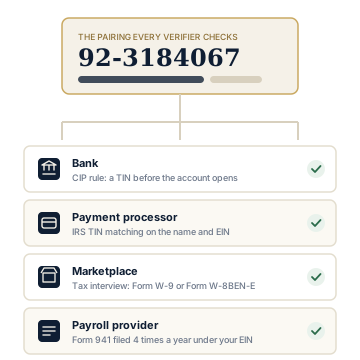
What does an EIN verification actually match?
It matches 2 fields, not 1. The IRS pairs every EIN with a name control built from the first 4 characters of the legal name. A verification passes when both the 9 digits and those 4 characters agree.
The name control is the mechanism behind almost every surprising rejection. The IRS stores it as a 4-character string derived from the legal name on Form SS-4. A reviewer at a bank compares the name you typed against the name on the CP-575, and an automated payer compares the name control the IRS holds against the name you wrote on Form W-9.
Punctuation changes the string. A legal name entered as L.L.C. produces a different first 4 characters than one entered as LLC. A leading article such as The moves every other character 4 places. A trading name, a DBA, and a website brand carry no weight at all, because the IRS holds 1 legal name per EIN and compares against that single record.
Read the 4-character rule in full on the IRS name control page, and the definitions behind each term on the ein glossary of terms page.
What does a US bank verify before it opens a business account?
A bank verifies 4 items under the Customer Identification Program rule at 31 CFR 1020.220: the legal name, a physical address, a formation date, and a taxpayer identification number. For a company, that number is the 9-digit EIN.
The rule comes from section 326 of the USA PATRIOT Act, and it applies to every US bank and credit union. The bank collects those 4 items before the account opens, then verifies them against documents. For an entity, the documents are the formation certificate from the state and the IRS letter carrying the EIN.
Two IRS letters satisfy the EIN half of that test. The CP-575 is issued exactly 1 time per EIN at assignment. The 147C is the replacement the IRS issues afterwards, at $0, to an authorized person. A bank accepts either, because both print the 9 digits beside the legal name in IRS records.
| CIP item | What a company supplies | Document that proves it |
|---|---|---|
| Legal name | The exact name on the formation certificate | State formation certificate |
| Address | A physical street address, not a PO box | Formation certificate or lease |
| Formation date | The date the state recorded the entity | State formation certificate |
| Identification number | The 9-digit EIN | CP-575 or 147C letter |
Source: 31 CFR 1020.220, verified July 2026.
One detail decides most bank outcomes. The legal name on the formation certificate and the legal name on the CP-575 are 2 separate records held by 2 separate authorities, and the bank compares them to each other. A company formed as Harbor Logistics LLC and filed with the IRS as Harbour Logistics LLC holds a valid EIN and fails the bank check on the letter H.
Read the anatomy of the letter the bank reads on the CP-575 page.
What do banks verify about the owners rather than the business?
Banks collect beneficial owners under 31 CFR 1010.230: every individual holding 25% or more of the equity, plus 1 control person such as a manager or officer. That produces up to 5 named individuals per account.
The ownership prong and the control prong work separately. Four owners at 25% each satisfy the ownership prong, and 1 person who runs the company satisfies the control prong, which is why 5 is the ceiling. A company with no owner above 25% still names 1 control person.
This is a separate test from the EIN check, and it is the reason a bank asks who the responsible party is even after the EIN passes. The IRS holds 1 responsible party per EIN, and the bank holds its own list of beneficial owners. The 2 lists disagree in real companies, and the bank asks about the gap.
A change of responsible party is reported to the IRS on Form 8822-B within 60 days. See who qualifies on the EIN responsible party page and the filing steps on the Form 8822-B page.
What do payment processors verify about an EIN?
A payment processor verifies the EIN against the legal name electronically, through IRS TIN matching. A mismatch holds payouts, because a payer that cannot verify a number applies 24% backup withholding under IRC 3406.
Processors sit in the reporting chain, so section 6109 of the Internal Revenue Code requires them to hold a correct taxpayer identification number for every account they pay. The check runs at onboarding and repeats when the account details change. It reads the same 2 fields a bank reads and returns an answer in seconds instead of days.
The failure mode is specific. A processor account opened under a brand name and an EIN issued to a legal name returns a mismatch every time, because the IRS holds the legal name. Entering the legal name in the tax field and the brand name in the display field resolves the whole class of problem, and no new EIN is needed.
When the mismatch persists, request a 147C letter and read the legal name the IRS prints, character for character. The procedure sits on the 147C letter page.
What do online marketplaces verify about an EIN?
A marketplace runs a tax interview that ends in 1 of 2 forms. A US entity signs Form W-9 and enters the EIN in Part I. A foreign entity signs Form W-8BEN-E and enters any US TIN on line 8.
The interview decides which form applies by asking about the entity type, the country of organization, and the tax classification. A US LLC completes Form W-9 regardless of where its owner lives, because the form follows the entity and not the person. That single point resolves most non-resident confusion at seller onboarding.
Line 1 of Form W-9 carries the legal name and line 2 carries the DBA. Sellers who reverse those 2 lines fail verification while holding a perfectly valid EIN. Part I then carries the 9 digits, and the signature attests that the pairing is correct.
| Entity in the tax interview | Form | Where the number goes | EIN required |
|---|---|---|---|
| US LLC, any owner nationality | Form W-9 | Part I, taxpayer identification number | Yes |
| US corporation | Form W-9 | Part I, taxpayer identification number | Yes |
| US partnership | Form W-9 | Part I, taxpayer identification number | Yes |
| Foreign company, no US entity | Form W-8BEN-E | Part I, line 8 | Where required |
Source: IRS instructions for Form W-9 and Form W-8BEN-E, verified July 2026.
What does a payroll provider verify about an EIN?
A payroll provider verifies the EIN and legal name before it files anything, because it files Form 941 for you 4 times a year and Form 940 once a year. Both returns carry your 9 digits.
Payroll is the strictest verifier on this page, because a rejected return creates a penalty rather than a delay. The provider signs and transmits federal returns under your EIN, so it verifies the pairing first and holds the CP-575 or the 147C letter on file as evidence.
The provider also collects state employer accounts, which are separate numbers issued by state agencies and never issued by the IRS. A business running payroll in 3 states holds 1 federal EIN and 3 sets of state registrations. Box b of every Form W-2 you issue then carries that same single federal EIN.
What does a US client verify before it pays an invoice?
A US client verifies the EIN and legal name on a signed Form W-9 before releasing payment. Without a verified number, the client withholds 24% of every payment under IRC 3406 and sends that share to the IRS.
The client needs the number to report the payment, so the request arrives before the first invoice clears. A vendor that supplies a correct Form W-9 removes the withholding entirely. A vendor that supplies a mismatched name and number triggers the notice chain instead.
That chain runs in a fixed order. The IRS sends the payer a CP2100 or CP2100A notice listing the mismatched accounts. The payer sends you a first B notice asking for a corrected Form W-9. A second mismatch inside 3 years produces a second B notice, which requires the IRS 147C letter itself rather than a self-certified form.
| Stage | Who acts | What resolves it | Withholding |
|---|---|---|---|
| Form W-9 supplied and verified | The vendor | Correct legal name and 9-digit EIN | 0% |
| CP2100 or CP2100A notice | The IRS notifies the payer | Payer reviews the account list | 0% |
| First B notice | The payer | A corrected Form W-9 | 24% until corrected |
| Second B notice within 3 years | The payer | An IRS 147C letter | 24% until corrected |
Source: IRC 3406 and IRS Publication 1281, verified July 2026.
What is IRS TIN matching and what does it return?
TIN matching is a free IRS e-Services check that confirms an EIN and a name belong together. Interactive matching accepts up to 25 combinations per session. Bulk matching accepts up to 100,000 in 1 file and answers within 24 hours.
The service is open to payers who file information returns, not to the general public, and it costs $0. It returns a result per combination rather than a document, so it confirms the pairing and reveals nothing else about the business. That design is why a processor verifies your EIN in seconds while a bank waits for a letter.
The check reads the same name control the IRS built at assignment. A payer submitting your brand name gets a mismatch even when the 9 digits are perfect, which is why the fix is almost never a new number. Send the legal name exactly as the CP-575 prints it and ask the payer to resubmit.
Walk through the confirmation steps yourself on the verify ein number page.
Which documents satisfy each EIN verifier?
Four documents carry EIN authority: the CP-575, the 147C letter, a filed federal return, and a signed Form W-9. Banks accept the first 2. Payers accept the fourth. Only the first 2 come from the IRS.
| Document | Issued by | Times issued | Bank accepts | Cost |
|---|---|---|---|---|
| CP-575 confirmation letter | The IRS | 1 per EIN | Yes | $0 |
| 147C verification letter | The IRS | On request | Yes | $0 |
| Filed Form 1120, 1065, or 941 | The business | Per filing period | As support | $0 |
| Signed Form W-9 | The business | On request | No | $0 |
| A screenshot of the number | Nobody | Not applicable | No | Not applicable |
Source: IRS notices and form instructions, verified July 2026.
The hierarchy is worth memorising, because it explains every document request you will receive. The IRS issues 1 CP-575 per EIN and never reprints it. The 147C exists to replace it. Every other record is a copy made by somebody other than the IRS, which is why a bank ranks it lower.
Read what the confirmation document contains on the EIN confirmation letter page, or recover a number you no longer hold on the lost EIN number page.
Why does a screenshot of an EIN get rejected?
A screenshot shows 9 digits and proves 0 pairings. Verification tests the EIN against the legal name in IRS records, and only the CP-575 and the 147C letter record that pairing on IRS letterhead.
The reviewer is not doubting your number. The reviewer needs a document that ties the number to a name, because a number without a name satisfies none of the 4 Customer Identification Program items. A photo of a screen supplies 1 field out of 2.
The same logic rejects a formation certificate submitted alone. The state issues that certificate and the state issues no EINs, so it proves the legal name and the formation date while proving nothing about the 9 digits. A bank asks for both documents because each one proves half the test.
Why does an EIN verification fail?
Five causes account for the failures: a name control mismatch, a brand name in the legal name field, an unreported name change, an EIN belonging to a different entity, and an entity that holds no EIN at all.
The name control does not match. The IRS reads the first 4 characters of the legal name. A period inside L.L.C. and a leading The each change that string, so the 9 digits pass and the record fails.
A brand name sits in the legal name field. The IRS holds 1 legal name per EIN. A storefront name, a domain, and a DBA return a mismatch on every check. Line 1 of Form W-9 takes the legal name and line 2 takes the DBA.
A name change was never reported. The EIN survives a legal name change and the IRS record does not update itself. Form 8822-B reports the new name, and a responsible party change is reported within 60 days.
The EIN belongs to a different entity. A parent and a subsidiary hold 2 separate EINs. A single-member LLC that added a member became a partnership, and the old number no longer describes the entity being verified.
The entity holds no EIN. A sole proprietor with no employees reports under a Social Security Number, so no EIN exists to verify. Form SS-4 creates one, and the IRS charges $0 for it.
Four of those 5 causes are record problems that a corrected form solves at $0. Only the fifth requires a new application. Rejected applications carry their own numbered codes, and those are decoded on the EIN reference number 101 page.
What do banks and platforms verify for a business owned from outside the US?
The same 2 fields: the 9-digit EIN and the exact legal name. Ownership nationality changes 0 items on the checklist. Form SS-4 line 7b accepts the entry Foreign, and the resulting CP-575 reads identically.
No verifier on this page asks for a Social Security Number from the business, because the business is identified by its EIN. A US LLC owned by 1 person living abroad completes Form W-9, not Form W-8BEN-E, because the form follows the entity. The beneficial ownership record names that owner under 31 CFR 1010.230 in the same way it names a US owner.
Getting the EIN without a Social Security Number
Form SS-4 line 7b accepts the word Foreign, so the IRS issues EINs to responsible parties who hold no SSN and no ITIN. The application moves from the online tool to fax. The IRS fax line is 855-641-6935 for entities based in a US state and 855-215-1627 for international applicants. The IRS international phone line is 267-941-1099. No identity document is filed with Form SS-4.
Have an SSN? irs.gov is free, and the online tool issues the EIN in 15 minutes.
One extra federal filing applies to a US disregarded entity that is 25% or more foreign-owned. That entity files Form 5472 with a pro forma Form 1120, and the penalty for failing to file it is $25,000 under IRC 6038A. The EIN is what makes that filing possible.
Read the complete no-SSN route on the EIN without SSN page, and the LLC-specific detail on the EIN for LLC page.
How long does each EIN verification take?
An electronic TIN match returns in seconds. A document review at a bank finishes inside 1 appointment. A 147C letter waits on IRS processing, and a new EIN by fax waits longer than every other row.
| Verification step | Time | Waits on the IRS | Cost |
|---|---|---|---|
| Interactive TIN match, up to 25 records | Seconds | No | $0 |
| Bulk TIN match, up to 100,000 records | Within 24 hours | Yes | $0 |
| Bank document review of a CP-575 | 1 appointment | No | $0 |
| Marketplace tax interview | Minutes | No | $0 |
| 147C letter request | Days to weeks | Yes | $0 |
| New EIN filed by fax | Weeks | Yes | $0 from the IRS |
Source: IRS e-Services and IRS processing guidance, verified July 2026.
Four of the 6 rows finish the same day with no IRS contact. The 2 slow rows are the 2 that request something from the IRS, which is the order to work in when a bank appointment is already booked. Model your own dates with the ein processing time estimator (tool), or read the method comparison on the how long does it take to get an EIN page.
When does a failed verification mean you need a new EIN?
In 1 case out of the 5 failure causes: the entity being verified holds no EIN. Corrected records fix the other 4. A new entity files Form SS-4, and the IRS charges $0.
A newly formed company facing a bank appointment sits in that case. So does a sole proprietorship that incorporated, and a single-member LLC that took on a second member and became a partnership. Each of those is a new entity to the IRS, and each one needs its own 9 digits before any verifier can pass it.
| Filed by | Price | Written deadline | Year 2+ |
|---|---|---|---|
| Yourself, direct to the IRS | $0 | None | $0 |
| ein-number.com | $99 | 7 business days or 100% automatic refund | $0 |
| Northwest | $200 | None | $0 |
| ZenBusiness | $99 | None | $0 |
Competitor prices verified July 2026. Northwest reflects the no-SSN rate. Business days are Monday to Friday, excluding US federal holidays.
The IRS charges $0 for an EIN through every method. The $99 covers preparation, filing within 1 business day of your completed details, 4 tracked stages, IRS monitoring, and a delivery date in writing. You can get started or file it yourself for nothing.