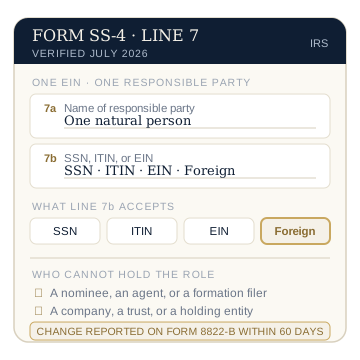
What is the EIN responsible party?
The EIN responsible party is the individual who controls, manages, or directs the entity and the disposition of its funds and assets. Form SS-4 line 7a carries the name. Line 7b carries the identifying number.
The IRS wrote the definition around a practical outcome rather than a job title. The question it asks is narrow: who can move the money. A person who signs the bank mandate, authorises transfers, and decides what the entity buys satisfies the test. A person listed in a filing cabinet does not.
The role attaches to the EIN itself, not to the entity. An entity holding 3 EINs across 3 subsidiaries records a responsible party on each of the 3 accounts, and the 3 records move independently. The IRS treats each EIN account as a separate file.
The 3 facts that define the role
One person, one EIN, one moment in time. Form SS-4 line 7a holds a single name. Co-founders with equal shares name 1 of the 2, and the second founder appears nowhere on the EIN record.
A natural person, with 1 exception. A government entity names itself. Every other applicant names a human being, so a holding company, a trust, or a law firm cannot occupy line 7a.
The record is permanent until it is replaced. No annual renewal exists and the EIN never expires. The name on file stays until Form 8822-B lines 8 and 9 replace it, which is due within 60 days of the change.
Source: IRS Form SS-4 instructions, verified July 2026.
What does control mean to the IRS?
Control means a level of entitlement to the entity’s funds or assets that, as a practical matter, enables the individual to direct the entity and the disposition of those assets. Ownership percentage is evidence, not the answer.
Two entities with identical cap tables produce different answers. A member holding 10% who is the sole signatory on the operating account exercises effective control. A member holding 60% who has no signature authority and no management role does not. Line 7a follows the signature, not the percentage.
Indirect control counts. The IRS definition reaches a person who directs the entity through another person or through another entity, which is why a fund manager and not the fund itself appears on the line. Apply the test in one sentence: if this person instructed the bank to send the balance abroad tomorrow, would the bank act.
| Fact pattern | Signature authority | Ownership | Responsible party |
|---|---|---|---|
| Sole founder, sole signatory | Yes | 100% | The founder |
| Two equal founders, one signs | One of 2 | 50% each | The signatory |
| Passive investor, active operator | Operator only | 60% investor | The operator |
| Family trust holds the LLC | Trustee signs | Trust owns 100% | The grantor or trustor |
| Parent corporation, new subsidiary | Officer signs | Parent owns 100% | A principal officer |
Source: IRS Form SS-4 instructions, line 7a, verified July 2026.
Who is the responsible party for each entity type?
A single-member LLC names its member. A corporation names a principal officer. A partnership names a general partner. A trust names the grantor. An estate names the executor. A government entity names itself.
The 9 entity types below cover the applicants the IRS sees. Read the proof column as the document a bank asks for when it checks the pairing, because the bank compares the name on line 7a with the name on the formation record.
| Entity | Responsible party on line 7a | Document that proves it | Line 3 entry |
|---|---|---|---|
| Single-member LLC | The individual member who owns it | Operating agreement or articles of organization | Blank |
| Multi-member LLC | One member or member-manager with control | Operating agreement naming the manager | Blank |
| Corporation | A principal officer, such as the president | Board resolution or corporate bylaws | Blank |
| Partnership | A general partner | Partnership agreement | Blank |
| Sole proprietorship | The owner, as an individual | No formation document exists | Blank |
| Trust | The grantor, owner, or trustor | The trust instrument | Trustee name |
| Estate of a decedent | The executor, administrator, or personal representative | Letters testamentary from the probate court | Executor name |
| Non-profit corporation | A principal officer or director | Board minutes | Blank |
| Government entity | The entity itself, the one exception to the individual rule | Authorizing statute or charter | Blank |
Source: IRS Form SS-4 instructions, lines 3 and 7a, verified July 2026.
Line 3 and line 7a solve different problems. Line 3 records the executor, administrator, trustee, or care-of name that receives correspondence. Line 7a records the person the IRS holds accountable for the account. A trust fills both, and an LLC fills only line 7a. Read the entity chapter on the EIN for LLC page.
What goes on Form SS-4 line 7a and line 7b?
Line 7a takes the responsible party’s legal first and last name. Line 7b takes their SSN, ITIN, or EIN. A responsible party holding none of the 3 enters the word Foreign on line 7b.
Enter the name as it appears on the identifying record, not as it appears on a business card. A middle initial that exists on the SSA record belongs on line 7a. A nickname does not. The IRS matches the entry against its own file, and a mismatch stalls the application.
| Line 7b entry | Who uses it | Online tool available | Route |
|---|---|---|---|
| SSN | A US citizen or resident individual | Yes, 15 minutes | irs.gov, free |
| ITIN | An individual with an IRS-issued ITIN | Yes, 15 minutes | irs.gov, free |
| EIN | Rare, and only where the instructions permit | No | Fax or mail |
| Foreign | An individual with no SSN and no ITIN | No | Fax, 855-215-1627 |
Source: IRS Form SS-4 instructions, line 7b, verified July 2026.
The name on line 1 and the name on line 7a serve separate matches. Line 1 is the legal name of the entity, and the IRS derives a 4-character name control from it. Line 7a is a person, and the two are matched independently. Walk the full form on the how to apply for an EIN page.
Can a company be the EIN responsible party?
No. Line 7a takes a natural person, with 1 exception: a government entity names itself. A parent corporation applying for a subsidiary EIN names a human officer, and the parent EIN goes on line 7b instead.
The rule exists because an EIN account needs an accountable human. An entity named on line 7a produces a chain that terminates in another entity, and the IRS cannot verify authority against a chain. Naming an officer ends the chain in 1 step.
Three structures hit this rule. A holding company forming an operating subsidiary names the officer who runs the subsidiary. A trust that owns an LLC names the grantor rather than the trust. A fund forming a special purpose vehicle names the manager rather than the fund. In all 3 cases the entity keeps its ownership, and the individual carries the record.
Line 7b accepts an EIN as an identifying number, which reads as a contradiction until you separate the 2 fields. Line 7a asks who the person is. Line 7b asks which number identifies them to the IRS. A person identified through an entity EIN still appears on line 7a by name.
Can a nominee be the EIN responsible party?
No. A nominee holds temporary authority during formation with little or no control over the entity’s assets. The IRS states a nominee cannot apply for an EIN, and an account carrying one is corrected on Form 8822-B.
A nominee entry creates a live exposure rather than a paperwork defect. The IRS releases EIN information to the person on file, so a nominee on the record can request a 147C letter for an account they no longer serve. Correcting it takes 1 form, 2 lines, and $0.
A registered agent. A registered agent receives service of process at a state address. That function grants no control over funds, so it fails the line 7a test in every state.
A formation filer. The person who signed the articles of organization holds a filing role. Forming the entity and directing its assets are 2 different acts.
An accountant or attorney. A professional advising the entity belongs on Form 2848 as a representative, not on line 7a. Form 2848 grants defined authority and leaves the responsible party unchanged.
A third party designee. The Form SS-4 designee block grants authority to receive the EIN. That authority terminates at the moment the EIN is assigned and released.
Source: IRS Responsible Parties and Nominees guidance, verified July 2026.
Can the responsible party have no SSN?
Yes. Form SS-4 line 7b accepts the entry Foreign when the responsible party holds no SSN and no ITIN. The application moves from the online tool to fax, and no identity document is filed with the form.
This is the single most misreported rule about line 7a. The IRS issues EINs to entities whose responsible party is a foreign individual, and the instructions print the word Foreign for exactly that case. The change is procedural: the online tool validates an SSN or ITIN in real time, so an application without one routes to fax instead.
The fax route, line by line
Line 7a carries the individual’s legal name. Line 7b carries the word Foreign. The completed Form SS-4 goes to 855-641-6935 for an entity based in a US state, or 855-215-1627 for an international applicant. The IRS international line for questions is 267-941-1099. No passport and no identity upload forms part of the filing.
Have an SSN? irs.gov is free, and the online tool issues the EIN in 15 minutes. No SSN? The fax route above works, or we file it.
Read the complete no-SSN reference on the EIN without SSN page. Expect a bank to check the responsible-party name you gave the IRS against the name on the account application before it opens the account.
What does the responsible party role actually grant?
The role grants access to the EIN account. The IRS releases EIN information, including a 147C letter, to the responsible party or to a representative named on a filed Form 2848. Nobody else reaches the record.
That single consequence explains why the entry matters years after the application. An owner who cannot find the CP-575 requests a 147C letter, and the IRS verifies authority before releasing the number. An owner whose name never reached line 7a fails that verification and files Form 8822-B first.
| Action on the EIN account | Responsible party | Form 2848 representative | Anyone else |
|---|---|---|---|
| Request a 147C letter | Yes | Yes | No |
| Receive IRS notices | Yes | Yes | No |
| Change the business address | Yes | Yes | No |
| Name a new responsible party | Yes | Yes | No |
| Close the EIN account | Yes | Yes | No |
| Receive the EIN at assignment | Yes | Yes | Designee, once only |
Source: IRS Form SS-4, Form 2848, and Form 8822-B instructions, verified July 2026.
The role grants no personal liability for the entity’s tax. It is an access and accountability record, not a guarantee. Read the replacement letter procedure on the 147C letter page, or recover a number you already hold on the EIN number lookup page. Banks compare the responsible party record against their own beneficial ownership list, and the full checklist sits on the ein verification requirements banks platforms page. The responsible party name on Line 7a also has to survive the four-character abbreviation the IRS derives from it, a matching rule worked through on irs name control.
How do you change the EIN responsible party?
File Form 8822-B. Line 8 carries the new name, line 9 carries their SSN, ITIN, or EIN. The change is due within 60 days. The IRS charges $0 and processes it in 4 to 6 weeks.
The 60-day rule comes from Regulations section 301.6109-1(d)(2)(ii) and binds every entity with an EIN. Count the 60 days from the date control actually moved, not from the date a document recorded it. A trustee replaced on 1 March starts the clock on 1 March, whether the deed of appointment is signed that week or the following month.
| Event | Form | Deadline | Same EIN |
|---|---|---|---|
| A controlling interest is sold | 8822-B, lines 8 and 9 | 60 days | Yes |
| A trustee is replaced | 8822-B, lines 8 and 9 | 60 days | Yes |
| An executor takes over an estate | 8822-B, lines 8 and 9 | 60 days | Yes |
| A nominee is removed | 8822-B, lines 8 and 9 | 60 days | Yes |
| The named officer resigns | 8822-B, lines 8 and 9 | 60 days | Yes |
| The business address changes only | 8822-B, lines 4a to 6 | No IRS deadline | Yes |
Source: IRS Form 8822-B instructions and Regulations section 301.6109-1(d)(2)(ii), verified July 2026.
The IRS charges no penalty for a late Form 8822-B. The exposure is different: an entity with a stale responsible party record does not receive a notice of deficiency or a notice of demand for tax, and interest continues to accrue on any deficiency. Work through the form line by line on the Form 8822-B page.
What goes wrong on line 7a?
Five errors account for most line 7a problems: an entity named instead of a person, a nominee, a name that does not match the identifying record, a stale record after a change, and a blank line 7b.
An entity sits on line 7a. A holding company or a trust on line 7a stops the application. Naming the officer, grantor, or manager fixes it in 1 edit before the fax goes out.
A nominee sits on the record. The IRS states a nominee cannot apply. An EIN issued with a nominee on file is corrected on Form 8822-B lines 8 and 9, at $0.
The name does not match the number. The IRS matches line 7a against the record behind the line 7b number. A married name on 1 record and a maiden name on the other fails that match.
The record went stale after a change. Founders leave and trustees are replaced. The 60-day clock runs from the date control moved, and a stale record blocks a 147C request years later.
Line 7b is left blank. A blank line 7b returns the application. A responsible party with no SSN and no ITIN enters the word Foreign, which is a valid entry and not an omission.
A rejected application returns an IRS reference number rather than an explanation. Reference 101 signals a name conflict, and the fix starts with the entity name and the responsible party entry. Read the codes on the EIN reference number 101 page.
When does a responsible party change require a new EIN?
A responsible party change never requires a new EIN. Form 8822-B updates the existing account within 60 days. A new EIN is required when the entity itself changes, and the IRS charges $0 for either transaction.
Separate the person from the entity. A new owner, a new officer, or a new trustee is a person change, and the EIN stays. A sole proprietorship that incorporates is a new entity, and a single-member LLC that admits a second member becomes a partnership. Both of those need their own EIN with their own line 7a.
| Filed by | Price | Written deadline | Year 2+ |
|---|---|---|---|
| Yourself, direct to the IRS | $0 | None | $0 |
| ein-number.com | $99 | 7 business days or 100% automatic refund | $0 |
| Northwest | $200 | None | $0 |
| ZenBusiness | $99 | None | $0 |
Competitor prices verified July 2026. Northwest reflects the no-SSN rate. Business days are Monday to Friday, excluding US federal holidays.
The IRS charges $0 for an EIN through every method. The $99 covers preparation, a line 7a entry checked against your formation document, filing within 1 business day of your completed details, IRS monitoring across 4 tracked stages, and a delivery date in writing. You can get started or file it yourself for nothing. Check whether your change needs a new number on the do I need a new EIN page.