Table of contents
- Is an EIN public record?
- Which law decides whether an EIN is public?
- Is a nonprofit EIN public record?
- Is a public company's EIN public record?
- Is a private company's EIN public record?
- Do state business records make an EIN public?
- Where does an EIN become visible in practice?
- Who is entitled to see your EIN?
- What can someone actually do with your EIN?
- Is an EIN more private than a Social Security Number?
- How do you keep an EIN out of public view?
- What do you do if your EIN is exposed?
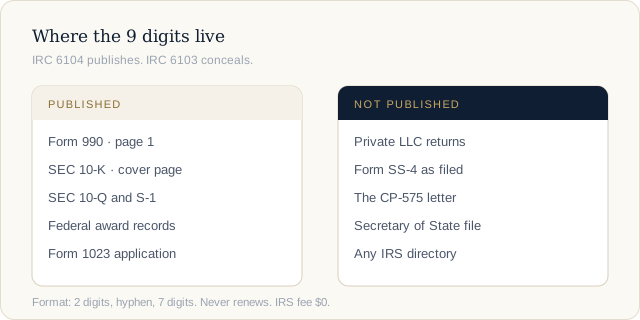
An EIN is public record for 2 categories of entity and private for every other one. Tax-exempt organizations publish theirs on Form 990 under Internal Revenue Code section 6104, and SEC registrants print theirs on the cover of every 10-K. A private company's EIN sits inside return information that section 6103 makes confidential, and the IRS operates no public EIN directory of any kind.
Search results on this question contradict each other because both answers are true for different entities. This page draws the line where federal law draws it, names the 2 code sections that decide it, and states what an exposed EIN costs a business in practice, which is far less than the question implies.
Is an EIN public record?
An EIN is public record only when the entity holding it files that number into a public system. Tax-exempt organizations and SEC registrants publish theirs by law. A private company's EIN stays unpublished, and no IRS directory lists it.
The question has one answer that splits cleanly in two, which is why the internet gives you both a yes and a no. Both are correct for different entities. The 9-digit number itself carries no privacy status. What decides the answer is the filing obligation attached to the entity that holds it.
Two disclosure regimes exist. One forces publication and applies to organizations that receive a public benefit: tax exemption, or the right to sell securities to the public. The other seals the number inside confidential return information and covers everyone else.
That distinction is worth holding onto because it answers every downstream question on this page. Whether a bank can look up your number, whether a competitor can find it, whether an exposed EIN needs replacing, all resolve from which side of the line the entity sits on.
An EIN also never changes to reflect exposure. The same 9 digits issued in 1998 remain in force in 2026, through a name change, an address change, and a move between all 50 states. Privacy on this number is a question about documents, not about the number.
Which law decides whether an EIN is public?
Two sections of the Internal Revenue Code. Section 6103 makes return information confidential, which covers a private company's EIN. Section 6104 forces tax-exempt organizations to open their exemption application and Form 990 returns to public inspection.
Section 6103 is the default. It bars the IRS from disclosing returns and return information, and an EIN reported on a return falls inside that definition. This is the reason the IRS answers no public request to identify the owner of a private EIN, at any price, from any requester.
Section 6104 is the carve-out. Congress attached a transparency condition to tax exemption: an organization that pays $0 in federal income tax opens its books. The exemption application, the determination letter, and the annual Form 990 all become available for public inspection, and the EIN prints on each.
Securities law creates the second carve-out through a different route. The SEC requires a registrant to identify itself on the cover page of its periodic reports, and the IRS Employer Identification Number is one of the required identifiers alongside the state of incorporation.
No third regime exists. There is no state statute that publishes EINs, no federal privacy law that unpublishes a Form 990, and no administrative process that moves an entity from one side of the line to the other while its filing obligations stay the same.
Is a nonprofit EIN public record?
Yes. Section 6104 requires a tax-exempt organization to make its Form 990 available for public inspection, and the EIN prints in the header on page 1. The IRS Tax Exempt Organization Search returns the same number for $0.
This is the most published EIN in existence. A registered charity's 9 digits appear in at least 4 places: the Form 990 header, the Form 1023 exemption application, the IRS determination letter, and the IRS Tax Exempt Organization Search database.
The publication is deliberate and it serves donors. A giver who wants to confirm that a solicitation comes from a real exempt organization runs the EIN through the IRS search and gets the legal name, the exempt status, and the ruling year back for $0.
Private foundations sit under the same rule through Form 990-PF, and the smallest organizations file the Form 990-N postcard, which also carries the EIN. Filing size changes the form, not the disclosure.
Watch the entity rather than the brand when you read one of these records. A national charity operates multiple registered entities, and a local chapter holds a different EIN from its parent organization, so the record that matters is the one attached to the entity issuing the receipt.
Is a public company's EIN public record?
Yes. An SEC registrant prints its IRS Employer Identification Number on the cover page of every 10-K, 10-Q, and S-1. EDGAR holds those filings permanently, free to read, with no account required.
The cover page is a fixed format, which is what makes this reliable. The registrant's exact legal name, its state of incorporation, and its IRS Employer Identification Number appear in the same block on every filing, and the company signs the document under penalty of law.
That signature is why an EDGAR record outranks every commercial data provider on the same fact. A reseller has copied the filing. The filing is the original.
Coverage is the boundary. EDGAR holds SEC registrants and the subsidiaries that file alongside them. A search returning nothing means the entity is not an SEC filer, and it carries no implication about the entity's size, revenue, or legitimacy.
A registrant that goes private stops filing, and the historical filings stay published. The EIN disclosed in a 2019 10-K remains readable in 2026 even after the company delists, because EDGAR is an archive rather than a live directory.
Is a private company's EIN public record?
No. A private LLC or corporation reports its EIN only on returns that section 6103 holds confidential. No federal database publishes it, no state agency lists it, and the IRS runs no public search that accepts a private EIN.
This is the case that covers every US business that is not an SEC registrant or an exempt organization. Their EIN appears on Form 1120, Form 1065, Form 941, and Form 940, and every one of those returns is confidential.
Sites that advertise a private EIN database are reselling the same 2 public sources described above. Test any of them with a private LLC you know the number for and the result is empty, because the underlying dataset does not contain private EINs and never has.
Confidential is not the same as secret. A private company hands its EIN to counterparties constantly, on a Form W-9, on an invoice, on a credit application, on a lease. Those disclosures are voluntary and bilateral rather than public.
The practical consequence is that finding a private company's EIN means asking the company. A signed Form W-9 delivers the number and the exact legal name together, which is the pairing that any verification actually needs.
Do state business records make an EIN public?
No. A state filing publishes the entity name, the registered agent, the formation date, and the filing number. It does not publish the EIN, because a Secretary of State never issues one and never receives one.
The confusion here is structural. Formation and federal tax identification are 2 separate acts with 2 separate agencies. The state creates the legal entity. The IRS assigns the 9-digit federal number afterward, on a separate form, with no data flowing back to the state.
This holds in all 50 states plus the District of Columbia. An EIN is federal, so a Wyoming LLC, a Delaware corporation, and a California partnership all receive the same kind of number from the same agency under the same rules.
Some state records do publish a state tax identification number, and that number is not an EIN. It is issued by the state revenue department for state-level sales or withholding tax, it uses a different format, and it is useless to anyone verifying a federal filing.
A state office cannot help you find or verify an EIN at all. State registries publish formation documents, registered agent details, and a state-issued filing number, none of which is the federal EIN the IRS assigns.
Where does an EIN become visible in practice?
Five routes: a Form 990 filing, an SEC cover page, a state licence or permit posted online, a court filing on a public docket, and a Form W-9 handed to a counterparty. Only the first 2 are true publication.
The court docket is the route people overlook. A complaint, a tax lien, or a bankruptcy schedule filed with the EIN printed on it enters a public docket, and commercial services index those dockets. A business with 0 filings against it appears in none of them.
Licensing is the messiest route. Some state and municipal licence registers post scanned application documents, and an EIN written on a scanned form becomes readable to anyone who opens the PDF. That is an administrative accident rather than a legal disclosure.
The W-9 route is the highest volume by a wide margin. A business with 40 vendor relationships has disclosed its EIN 40 times in writing, each time to a party that keeps the form on file for at least 4 years to support its own 1099 reporting.
Rank those 5 routes by volume and the worry inverts. The 2 legal publication routes reach only the 2 categories of entity named at the top of this page. The other 3 reach everyone else, and each one begins with a document the business signed and handed over itself.
Who is entitled to see your EIN?
Anyone who pays you, anyone you pay, your bank, your payroll provider, your accountant, and the IRS. Form W-9 exists to transfer the number, and a payer needs it to file a 1099 correctly.
The W-9 is the standard instrument. A payer requests one before issuing payment, the recipient enters the exact legal name and the 9-digit number, signs, and returns it. The payer keeps it and reports payments under that number.
A mismatch between the name and the number on that form produces a CP2100 notice to the payer and backup withholding on subsequent payments. That consequence is the reason payers verify rather than assume, and it is the single most common trigger for an EIN verification request.
Banks sit in the same category with a stricter document standard. Opening a business account means presenting the CP-575 or a 147C letter alongside formation documents, because a bank verifies the name and number pairing against an IRS-issued document rather than against a typed number.
None of these disclosures make the number public. Each is a private transfer to a party with a reporting obligation, and each of those parties has its own duty to safeguard the file.
What can someone actually do with your EIN?
An EIN alone opens no account and files no return. A bank pairs it with formation documents, the CP-575, and a verified responsible party. Fraud needs the whole set, so an exposed EIN is not an exposed identity.
The gap between an EIN and a usable business identity is wide. Every EIN on Form 990 is published to the entire internet, and those organizations run for decades without the disclosure causing harm, which is the clearest available evidence that the number by itself is low value to a bad actor.
The 2 documented misuse patterns both require more than the number. The first is filing a fraudulent return under a business identity, which requires the officers, the address, and prior-year figures. The second is opening trade credit, which requires formation documents and a control person who passes verification.
The number that does carry standalone risk is the Social Security Number, and the difference is the reason to keep them separate. A sole proprietor who reports under an SSN prints it on every W-9 they issue. Getting an EIN removes the SSN from that circulation entirely.
Treat the CP-575 as the sensitive item rather than the number. The letter is the document a bank accepts as proof, it is issued exactly once, and the IRS never reissues it. A 147C letter replaces its function, and the CP-575 itself is gone for good once lost.
Is an EIN more private than a Social Security Number?
An EIN is less private by design. It prints on W-9s, 1099s, and invoices that circulate freely. An SSN prints as 3 digits, 2 digits, then 4, and no legitimate business publishes one anywhere.
The formats alone signal the difference. An EIN prints as 2 digits, a hyphen, then 7 digits, in the pattern 12-3456789. An SSN prints in a 3-2-4 pattern as 123-45-6789. A reader who sees the hyphen after the second digit is holding a business number, not a personal one.
Design intent follows format. The EIN exists so that a business identifies itself in commerce without exposing an individual, which makes circulation the feature rather than the flaw. Handing an EIN to 40 vendors is the system working correctly.
This is also the strongest practical argument for a sole proprietor to get one. Without an EIN, every W-9 that goes out carries an SSN, and each of those copies sits in a filing cabinet or a shared drive at another company for at least 4 years.
The IRS charges $0 for the number that ends that exposure, and it never renews, so the year 2 cost is $0 as well.
How do you keep an EIN out of public view?
Give it only where a form requires it, keep the CP-575 offline, use a business address on Form SS-4 rather than a home address, and file Form 8822-B within 60 days when the responsible party changes.
The address choice on the application does more work than anything else on this list. Line 4 of Form SS-4 takes a mailing address, and whatever goes there travels with the record. A home address entered once becomes the address the IRS mails to, which pulls a residence into a business file.
Redaction discipline handles the documents. When a landlord, a marketplace, or a platform asks for proof of the EIN, the CP-575 shows the name, the number, and the address together. Sending only the pages a counterparty needs keeps the rest of the letter out of circulation.
Form 8822-B closes the accuracy gap. The IRS asks for it within 60 days of a change of address or responsible party, and a record that matches reality is a record that resists someone else claiming the entity.
None of this applies to an organization filing Form 990. Publication there is a legal condition of exemption, and no filing removes an EIN from a return that is already open to public inspection.
What do you do if your EIN is exposed?
The IRS does not reissue an EIN because of exposure, and the 9 digits never change. Notify your bank, watch for filings under the number, and request a 147C letter to confirm the record the IRS holds.
Start by confirming what the IRS has on file. A 147C letter restates the EIN and the exact legal name attached to it, and the IRS releases it only to the responsible party or another authorized person. International callers reach the IRS at 267-941-1099.
Check the responsible party next. That field is the control point on the record, and Form 8822-B is the only instrument that changes it. A responsible party that still reads correctly means nobody has moved the entity underneath you.
Tell the bank before anything happens rather than after. A business account already holds your CP-575 on file, and a note on the account is faster than a dispute.
A new EIN is warranted only when the entity structure changes, not when a number leaks. Converting a sole proprietorship to a corporation, or a single-member LLC electing corporate taxation, are the events that create a genuine need for a second number.
Which records publish an EIN and which never do?
Three record types publish an EIN to the open internet: a Form 990, a Form 1023 exemption application, and an SEC cover page. Five records that carry the number stay closed, including Form SS-4, the CP-575, and a signed W-9.
| Record | Carries the EIN | Open to the public | Legal basis | Cost to read |
|---|---|---|---|---|
| Form 990 (tax-exempt) | Yes, page 1 header | Yes | IRC section 6104 | $0 |
| SEC 10-K, 10-Q, S-1 | Yes, cover page | Yes | SEC reporting rules | $0 |
| Form 1023 exemption application | Yes | Yes | IRC section 6104 | $0 |
| Form 1120, 1065, 941, 940 | Yes | No | IRC section 6103 | Not available |
| Form SS-4 as filed | Yes, line 1 and the assigned number | No | IRC section 6103 | Not available |
| CP-575 assignment letter | Yes | No | Issued once to the entity | Not available |
| 147C verification letter | Yes | No | Released to an authorized person | $0 from the IRS |
| Secretary of State formation file | No | Yes | State law, all 50 states | $0 to search |
| A signed Form W-9 | Yes, Part I | No, bilateral only | 1099 reporting duty | $0 to request |
| An IRS public EIN directory | Does not exist | No | No such system | Not applicable |
Sources: Internal Revenue Code sections 6103 and 6104, IRS forms and instructions, and SEC filing requirements. Verified July 2026.
What does an EIN filing service charge, and is that price public?
The IRS charges $0 for an EIN and $0 in year 2, because the number never renews. Services charge for preparation and filing, and those prices are published openly, unlike the EIN itself.
| Route | Price | Written delivery deadline | Year 2 cost |
|---|---|---|---|
| IRS, direct | $0 | None | $0 |
| ein-number.com | $99 | 7 business days or full refund | $0 |
| IRS fax route, line 7b Foreign | $0 | None | $0 |
IRS fee and renewal cost verified July 2026. The IRS fee for an EIN is $0 by every route, and no route carries a written delivery deadline except ours.
The price of the number and the price of the filing are 2 different figures, and only one of them is $0. The IRS charges $0 for the EIN itself on all 3 routes above, in all 50 states, in year 1 and in year 2, because the number never renews. What a paid filing buys is preparation of Form SS-4, transmission to the correct fax line of the 2 the IRS operates, and a deadline that someone owes you in writing.
That is also why the filing price is public while the EIN is not. A published price is a commercial term a buyer compares before paying. The 9-digit number is return information under section 6103, and no published price list, invoice, or receipt anywhere moves it out of that category.
Does the privacy answer change without an SSN?
No. An EIN issued to a responsible party with no SSN sits under the same 2 code sections as every other EIN. Form SS-4 line 7b accepts the entry Foreign, and nothing about the record differs afterward.
The online IRS application requires an SSN or ITIN, which is why an applicant without one uses the fax route instead. Line 7b of Form SS-4 takes the word Foreign in place of an identifying number, and the completed form goes to 855-641-6935 for an entity based in a US state, or 855-215-1627 for an international entity. No passport is required at any point in the process.
The resulting EIN is identical in every respect. Same 9 digits in the same 2-and-7 format, same CP-575 letter, same confidentiality under section 6103, same $0 renewal cost forever. The IRS also answers international callers at 267-941-1099 for questions on a filed application.
Have an SSN? Apply directly at irs.gov. It is free and takes 15 minutes. Paying anyone for that is paying for nothing.
No SSN? The online application closes to you. Take the fax route with line 7b marked Foreign, or we file it for $99 and deliver within 7 business days.
What else do people ask about EIN privacy?
+Is an EIN public record?
For 2 categories of entity, yes. Tax-exempt organizations publish theirs on Form 990 under Internal Revenue Code section 6104, and SEC registrants print theirs on every 10-K cover page. For every private company, no: section 6103 makes the number confidential return information, and the IRS runs 0 public EIN directories.
+Can anyone look up my business EIN?
Not if the business is private. There is no public database of private company EINs, and the IRS answers no request to identify one. A tax-exempt organization is the opposite case: its 9 digits are searchable for $0 through the IRS Tax Exempt Organization Search, which returns the legal name, the exempt status, and the ruling year.
+Is an EIN confidential information?
It is confidential in IRS hands under section 6103 and routine in commerce. A business hands the number to every payer on a Form W-9, and a company with 40 vendor relationships has disclosed it 40 times. Confidential describes the IRS duty, not a restriction on the business itself.
+Can someone steal my business with my EIN?
Not with the 9 digits alone. A bank requires the CP-575 or a 147C letter, formation documents, and a verified responsible party before opening an account. Every Form 990 filer publishes its EIN to the entire internet and operates for decades without harm, which shows the number carries low standalone value.
+Why is a nonprofit EIN published but mine is not?
Publication is the price of exemption. An organization that pays $0 in federal income tax opens its Form 1023 application, its determination letter, and its annual Form 990 to public inspection under section 6104. A taxable private company makes no such trade, so section 6103 confidentiality applies to it instead.
+Does my state publish my EIN?
No. A Secretary of State publishes the entity name, registered agent, formation date, and filing number, across all 50 states. It never issues or receives an EIN, because the EIN is federal. A state tax identification number is a different number in a different format from a different agency.
+Should I change my EIN if it leaks?
No. The IRS does not reissue an EIN over exposure, and the same 9 digits stay in force from 1998 through 2026 and beyond. Request a 147C letter to confirm the record, check the responsible party, and file Form 8822-B within 60 days if anything on the record is wrong.
+Is an EIN safer to share than an SSN?
Yes, and that is the point of it. An EIN prints as 2 digits, a hyphen, then 7. An SSN prints in a 3-2-4 pattern. A sole proprietor without an EIN puts an SSN on every W-9, and each copy sits in another company's files for at least 4 years.
+Can I get an EIN without an SSN, and does that change the privacy answer?
Yes to the first, no to the second. Form SS-4 line 7b accepts the entry Foreign for a responsible party with no SSN or ITIN, and the completed form goes to the IRS by fax at 855-641-6935 or 855-215-1627. Privacy rules apply identically to every EIN.
+What does it cost to get an EIN, and is the application itself public?
The IRS charges $0, and the year 2 cost is $0 because an EIN never renews. Form SS-4 as filed is confidential return information for a taxable entity. ein-number.com prepares and files it for $99 and delivers the EIN and CP-575 within 7 business days or refunds automatically.
This page states Internal Revenue Code provisions, IRS procedures, and SEC filing requirements current as of July 2026. It is not legal or tax advice. ein-number.com is not affiliated with the IRS.
Situation requires a new EIN? Seven business days, in writing.
Exposure never requires a new number. A change of entity structure does. When that is your case, we prepare Form SS-4, file within 1 business day of receiving complete details, and deliver the 9-digit EIN and the official IRS CP-575 letter within 7 business days or refund the $99 automatically. The IRS fee stays $0, the application continues free until delivery, and 4 tracked stages report progress: received, verified and filed, monitoring, delivered.
No SSN. No passport upload. · get your EIN number in 7 business days