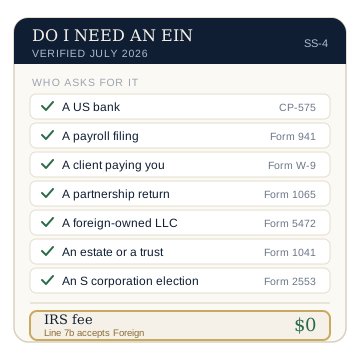
Do I need an EIN?
Yes, when one of 9 federal filing obligations attaches to your business: payroll, a partnership return, a corporate return, excise tax, withholding on a non-resident, an estate or trust, Form 5472, a retirement plan, or tax-exempt status.
The question has one honest structure and most answers online blur it. A requirement comes from a federal filing obligation. A request comes from a counterparty. The first is law and applies with $0 of revenue. The second is a private policy, and a Social Security Number satisfies it in the cases listed further down this page.
Read the two lists in order. If any of the 9 triggers below applies, the decision is made and nothing else matters. If none applies, move to the requester list, where the answer depends on who is asking and what document they verify.
| Your situation | EIN required | What decides it |
|---|---|---|
| Sole proprietor, 0 employees, 0 excise | No | Reports on Schedule C under an SSN |
| Sole proprietor, 1 or more employees | Yes | Form 941 and Form W-2 carry an EIN |
| Single-member LLC, US owner, 0 employees | No | Disregarded entity, reports on Schedule C |
| Single-member LLC, foreign owner | Yes | Form 5472 and pro forma Form 1120 |
| Multi-member LLC | Yes | Files Form 1065 as a partnership |
| Corporation, C or S | Yes | Files Form 1120 or Form 1120-S |
| Partnership of any size | Yes | Files Form 1065 |
| Estate of a decedent | Yes | Form 1041 at $600 of gross income |
| Irrevocable trust | Yes | Files Form 1041 under its own number |
| Tax-exempt organization | Yes | Form 1023 and annual Form 990 |
Source: IRS forms and instructions, verified July 2026.
The same 9 digits carry several names on official paperwork. A bank form that asks for a federal tax id number is asking for the EIN, and a form that asks for a TIN accepts it too.
Who is asking you for an EIN?
Seven parties ask: the IRS on a return, a bank at account opening, a payroll provider, a marketplace or payment processor, a client sending a Form W-9, a state tax agency, and an insurer or licensing board.
Identifying the requester answers the question faster than any entity chart, because each one verifies a different document and each one accepts a different substitute. The table below records what the request actually requires.
| Who asks | Where the number goes | Document verified | SSN accepted instead |
|---|---|---|---|
| The IRS | Page 1 of the entity return | IRS records | No, for entity returns |
| A US bank | Business account application | CP-575 or 147C letter | Sole proprietors only |
| A payroll provider | Form 941 and Form W-2 box b | CP-575 letter | No |
| A marketplace or processor | Form W-9 for a US entity | Name and EIN match | Sole proprietors only |
| A client paying you | Form W-9 you sign | The signed form | Sole proprietors only |
| A state tax agency | State registration form | The federal EIN | Varies by state |
| An insurer or licensing board | The application form | CP-575 letter | Varies by body |
Source: IRS forms and standard financial-institution practice, verified July 2026.
One pattern runs through the whole table. Every party that verifies rather than collects asks for the CP-575 or a 147C letter, because those are the only two documents that record the pairing of an EIN with a legal name directly from IRS records. Read what a CP-575 contains before your first verification request arrives.
Which federal rules make an EIN mandatory?
Nine filing obligations make it mandatory: payroll on Form 941, a partnership on Form 1065, a corporation on Form 1120, excise on Form 720, withholding on Form 1042, an estate on Form 1041, Form 5472, Form 5500, and tax exemption.
Each trigger below is independent. One of them is enough, and revenue is not part of any of them. A dormant partnership with $0 of income files Form 1065 and needs the number as surely as a company with payroll running every fortnight.
Trigger 1: You pay wages to an employee
Payroll reporting carries the employer EIN in the identification block of Form 941 each quarter, on Form 940 each year, and in box b of every Form W-2. No payroll filing accepts a Social Security Number in that field.
Trigger 2: Your business is taxed as a partnership
A partnership files its own return under its own number. A single-member LLC that admits a second member becomes a partnership on that date and needs an EIN from that date.
Trigger 3: Your business is taxed as a corporation
A corporation is a separate taxpayer. An LLC that elects corporate treatment on Form 8832, or S corporation treatment on Form 2553, becomes one too, and both forms require an EIN before they are filed.
Trigger 4: You file an excise tax return
Federal excise categories include fuel, heavy trucks, indoor tanning, and certain communications services. The return is filed quarterly under an EIN, and the requirement stands with zero employees.
Trigger 5: You withhold tax on payments to a non-resident
A withholding agent reports under an EIN. The obligation attaches to the payer, so a US business paying a foreign contractor or a foreign owner reports under its own number.
Trigger 6: You administer an estate or a trust
An estate files Form 1041 once its gross income for the year reaches $600. A trust that becomes irrevocable stops reporting under the grantor's Social Security Number and reports under an EIN of its own.
Trigger 7: You run a foreign-owned single-member LLC
A US LLC with a foreign owner files Form 5472 to report transactions with that owner. The filing requires an EIN, and the penalty for a missed or incomplete Form 5472 starts at $25,000.
Trigger 8: You sponsor a retirement plan
A Keogh plan, a solo 401(k), or any qualified plan reports under an employer identification number. A sole proprietor with no employees crosses into the requirement the moment the plan opens.
Trigger 9: Your business is a tax-exempt organization
An exemption application is filed under an EIN, and the annual Form 990 prints that EIN on page 1. The IRS publishes both, which is why nonprofit EINs are the most openly available category.
Source: IRS Form SS-4 instructions and the linked return instructions, verified July 2026.
What happens when you operate without an EIN?
A business that needs one and has none cannot file the return that triggered the requirement. The return is still due, the deadline does not move, and a missed Form 5472 carries a penalty starting at $25,000 per return.
The consequence is a chain rather than a single fine. Without the number there is no return, and without the return there is a late filing, and a late filing is what the penalty attaches to. The absence of the EIN is never the charge on its own.
A return cannot be filed at all. Form 1065, Form 1120, Form 941, and Form 1041 each open with an identification block that has no valid entry other than an EIN. A return submitted without one is not accepted.
A Form 5472 obligation runs at $25,000. A foreign-owned single-member LLC files Form 5472 with a pro forma Form 1120. The penalty for a missed or incomplete return starts at $25,000, and it applies for each reportable year.
Payroll stops before it starts. A payroll provider files Form 941 quarterly and Form W-2 annually under the employer EIN. Neither filing accepts a Social Security Number, so the first payroll run waits on the number.
A bank application halts at verification. A US bank matches the legal name against the EIN on the CP-575 before it opens a business account. No account means no card processing, no payouts, and no supplier terms.
Backup withholding starts on your income. A payer that receives a Form W-9 with no valid taxpayer identification number withholds from the payment instead. Money reaches the IRS rather than the business until the number is supplied.
Do banks and payment platforms require an EIN?
A bank requires one for every entity account, and it accepts a Social Security Number only from a sole proprietor. A payment platform requires a taxpayer identification number before it releases payouts, and an EIN satisfies that request.
Two different checks run behind these requests. A bank performs a name-and-number match against the CP-575, character for character, which is why an entity registered as Harbor Lane LLC fails a check submitted as Harbor Lane L.L.C. A platform performs a taxpayer identification number match before it issues the annual information return on your earnings.
The practical difference is what a mismatch costs. A failed bank match delays an account opening by the length of a document request. A failed platform match starts backup withholding on payouts already earned, which is why the number is supplied before the first sale rather than after it.
| Account type | EIN required | Substitute accepted | Proof requested |
|---|---|---|---|
| LLC business account | Yes | None | CP-575 and formation document |
| Corporate business account | Yes | None | CP-575 and articles |
| Sole proprietor account | No | Social Security Number | SSN and a DBA registration |
| Partnership account | Yes | None | CP-575 and the partnership agreement |
| Trust account | Yes | None | CP-575 and the trust instrument |
| Marketplace seller payout | For entities | SSN for sole proprietors | Form W-9 name and TIN match |
Source: IRS Form W-9 instructions and standard account-opening practice, verified July 2026.
See the full list of checks a counterparty runs on the what banks and platforms verify page.
When in the setup sequence do you apply for an EIN?
Apply after the state approves the entity and before the first bank appointment. Form SS-4 asks for the legal name and the date of formation, so an EIN issued against an unapproved name creates a mismatch.
Sequence matters because two government records have to agree. The state records the legal name on the formation certificate. The IRS records the same name against the EIN. Every downstream check compares the two, and a difference of one character in either direction is what fails a bank application.
| Step | What happens | Blocks the next step |
|---|---|---|
| 1 | The state approves the entity and issues the formation document | Yes |
| 2 | Form SS-4 is filed with the approved legal name and formation date | Yes |
| 3 | The IRS assigns the EIN and issues 1 CP-575 letter | Yes |
| 4 | The bank opens the account against the CP-575 | Yes |
| 5 | A payment platform matches the Form W-9 name and EIN | No |
| 6 | Payroll registers the EIN with the provider | No |
Source: IRS Form SS-4 instructions, verified July 2026.
Work backwards from the date the number is needed. Read the full method comparison on the how long does it take to get an ein page, then work through the form itself on the how to apply for an EIN page.
Do you need an SSN to get an EIN?
No. Line 7b of Form SS-4 accepts the entry Foreign, so the IRS issues EINs to responsible parties holding no SSN and no ITIN. The application moves to fax, and no identity document is filed with it.
The online tool at irs.gov validates an SSN or an ITIN before it proceeds, which is the single reason a non-resident applicant leaves it. Nothing about the underlying entitlement changes. The same Form SS-4 travels by fax, the IRS reviews the same information, and the same 9-digit number comes back.
Applying without a Social Security Number
Enter the responsible party name on line 7a and the word Foreign on line 7b. Fax the completed Form SS-4 to 855-641-6935 when the entity is based in a US state, or to 855-215-1627 from outside the United States. The IRS international line for applicants is 267-941-1099. No passport, no visa, and no US visit enters the process at any point, and the IRS fee remains $0.
Have an SSN? irs.gov is free, and the online tool issues the EIN in 15 minutes. That route costs you nothing and we say so plainly.
The complete no-SSN reference sits on the EIN without SSN page, and the distinction between the two identification numbers sits on the EIN vs ITIN page.
Do you need a second EIN?
Each legal entity holds 1 EIN, so a second company needs its own. A trade name added to an existing entity needs none. The IRS issues 1 EIN per responsible party per day through the online tool.
The rule follows the entity rather than the brand. One LLC running 4 storefronts under 4 trade names files 1 return under 1 EIN, because a DBA is a registration and not a taxpayer. Two LLCs running 1 brand between them hold 2 EINs, because each files its own return.
| The change | Second EIN | The rule |
|---|---|---|
| You register a DBA or trade name | No | The EIN belongs to the legal entity behind it |
| You open a second location | No | 1 entity files 1 return |
| You form a second LLC | Yes | A new entity is a new taxpayer |
| Your single-member LLC admits a partner | Yes | It becomes a partnership filing Form 1065 |
| Your sole proprietorship incorporates | Yes | The corporation is a separate taxpayer |
| You change the business name only | No | Record it on Form 8822-B |
| You move to a new state address | No | Record it on Form 8822-B |
| You elect S corporation status | No | Form 2553 keeps the existing EIN |
Source: IRS guidance on when a new EIN is required, verified July 2026.
The full entity-change matrix sits on the when do you need a new EIN page, and the address and responsible-party filing sits on the Form 8822-B page.
What does an EIN cost and how long does it take?
The IRS charges $0 on every route, and the number never renews, so year 2 costs $0. Online issue takes 15 minutes with an SSN. Fax takes 4 business days. Mail takes 4 weeks.
Two prices exist and only two. The government price is $0. The service price is whatever a private company charges to prepare and file the same Form SS-4, and what separates one service from another is whether a delivery date is written down.
| Filed by | Price | Written deadline | Year 2+ |
|---|---|---|---|
| Yourself, direct to the IRS | $0 | None | $0 |
| ein-number.com | $99 | 7 business days or 100% automatic refund | $0 |
| Northwest | $200 | None | $0 |
| ZenBusiness | $99 | None | $0 |
| Rocket Lawyer | $59.99 | None | $0 |
Competitor prices verified July 2026. Northwest reflects the no-SSN rate. Business days are Monday to Friday, excluding US federal holidays.
The IRS charges $0 for an EIN through every method, and this page states that before it states anything else. The $99 covers preparation, filing within 1 business day of your completed details, 4 tracked stages, IRS monitoring, and a delivery date in writing. The homepage sets out the full terms of that commitment: EIN number delivery, in writing. You can also file the same form yourself for nothing. Compare every fee on the EIN cost page.